





What's Happening?
The ASEAN+3 Macroeconomic Research Office (AMRO) has increased its forecast for South Korea's economic growth rate this year to 3.3%, a 0.2 percentage point rise from its previous projection three months ago. This upward revision follows a significant
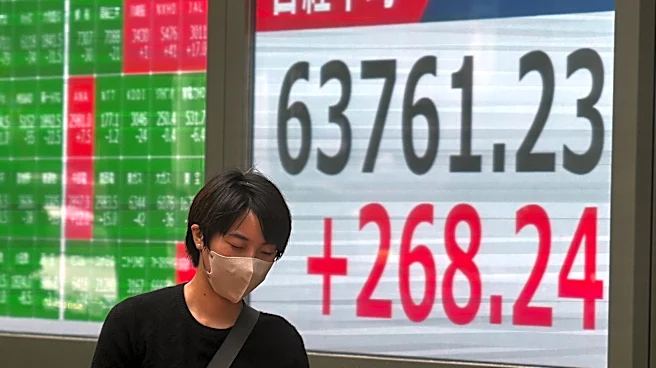
adjustment in April, when the forecast was drastically raised from 1.1% to 3.1%. The Asian Development Bank (ADB) also upgraded its economic growth forecast for South Korea to 3.3%. AMRO's latest projection aligns closely with the Bank of Korea's 3.3% and the Korea Development Institute's (KDI) 3.2% estimates, though it remains below the Organization for Economic Cooperation and Development's (OECD) 3.7%. For inflation, AMRO raised its forecast for this year from 2.6% to 2.7% but lowered next year's projection from 2.4% to 2.3%. The overall ASEAN+3 region is expected to grow by 4.1% in both this year and next, with strong export and investment demand related to artificial intelligence (AI) partially offsetting the decline in domestic demand caused by rising energy prices.
Why It's Important?
This upgraded growth forecast for South Korea signals a robust economic performance driven by external demand, particularly in technology sectors like AI. For U.S. businesses and investors, South Korea's strong growth indicates a healthy market for exports and potential investment opportunities, especially in advanced technology and manufacturing. The emphasis on AI-related demand highlights the increasing global importance of technological innovation as a growth driver. However, AMRO also identified several downside risks that could impact the region, including a potential weakening of AI-related demand, ongoing conflicts in the Middle East driving up energy and production costs, and climate phenomena like El Niño affecting food prices. These risks underscore the interconnectedness of global economies and the potential for external factors to disrupt even strong growth trajectories, affecting U.S. companies with supply chains or market interests in Asia.
What's Next?
While the immediate outlook is positive, AMRO assessed that downside risks are likely to dominate the region's economic outlook going forward. These risks include a potential contraction in regional exports and investment if AI-related demand weakens. The ongoing Middle East conflict could further escalate energy, transportation, and production costs, while abnormal climate events like El Niño may lead to higher food prices. Other risk factors mentioned include potential corrections in equity markets driven by strong technology stocks, rising government bond yields in major economies, sudden shifts in U.S. monetary policy expectations, and increased trade costs due to protectionist measures. Structurally, geopolitical fragmentation, population aging, and climate change pose long-term risks. South Korea and the broader ASEAN+3 region will need to monitor these factors closely and implement adaptive policies to mitigate potential negative impacts and sustain their growth momentum.
Beyond the Headlines
The report's focus on AI-related demand as a key growth driver points to a significant shift in global economic engines, where technological advancements are increasingly central to national prosperity. This trend has profound implications for U.S. technology companies and their competitive landscape. The identified downside risks, particularly geopolitical conflicts and climate change, highlight the fragility of global economic stability despite strong sectoral performance. The mention of potential corrections in equity markets led by technology stocks and shifts in U.S. monetary policy underscores the interconnectedness of global financial systems and the ripple effects of policy decisions in major economies. This situation prompts a deeper consideration of how nations can build resilience against both economic and non-economic shocks, and how international cooperation, particularly in areas like climate change and supply chain stability, becomes increasingly vital for sustained global growth.