

What's Happening?
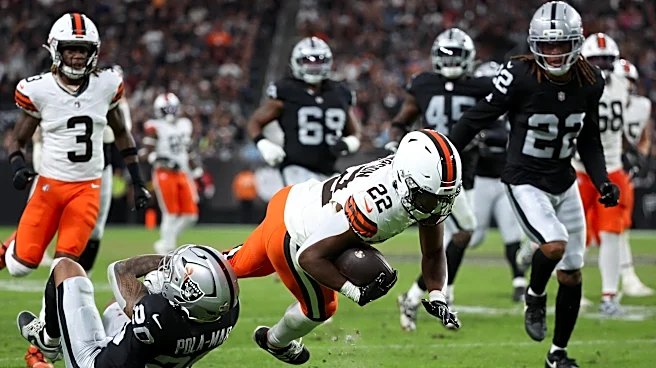
Dylan Sampson, a running back for the Browns, is taking on a significantly larger and more critical role within the team, particularly in third-down and two-minute situations. Despite a knee injury that sidelined him for five games earlier in the season,
Sampson has returned to become the full-time third-down back. This expanded responsibility includes being on the field for crucial end-of-game scenarios, a trust that Sampson acknowledges and takes seriously. His coaches, including running backs coach Duce Staley and general manager Andrew Berry, have recognized his versatility and ability to adapt. Staley noted that Sampson's college tape primarily showed him as a downhill runner, but he has successfully transitioned to a more versatile role in the NFL, including pass protection. Sampson's performance since his return has been impactful, with 19 rushes for 79 yards and 16 receptions for 152 yards in four games. This shift in playing time has seen him on the field for more snaps than fellow running back Quinshon Judkins in recent games.
Why It's Important?
This development is important for the Browns as it highlights the team's strategic adaptation and player development. Sampson's emergence as a reliable third-down back provides the offense with a crucial asset for maintaining drives and converting in high-pressure situations. His ability to contribute in both the run and pass game, coupled with his improved pass protection, makes him a valuable and versatile weapon. For the team, having a player who can excel in critical moments, such as two-minute drills, directly impacts game outcomes and offensive efficiency. This also demonstrates the coaching staff's confidence in Sampson's mental and physical capabilities, especially after recovering from an injury. The increased workload for Sampson could also influence the team's offensive play-calling and strategy, potentially leading to a more dynamic and unpredictable attack. His success in this role could also alleviate pressure on other offensive players and contribute to overall team performance.
What's Next?
Moving forward, Sampson is expected to continue in his expanded role, with coaches expressing a willingness to give him more opportunities. Coach Todd Monken has made a concerted effort to get Sampson the ball, including both outside runs and catches, and even inside runs. His versatility, particularly in the pass game and protections, is seen as critical for the team. The coaching staff believes that with continued health and experience, Sampson will only get better. His ability to consistently perform in critical situations will be key to maintaining his prominent role. The team will likely continue to leverage his skills in third-down and two-minute scenarios, and his development could lead to an even more significant presence in the Browns' offensive scheme as the season progresses. The focus will be on his continued growth in pass protection and overall versatility.
Beyond the Headlines
Sampson's journey from a college workhorse to a versatile NFL back highlights the significant adaptation required for players transitioning to the professional level. His success in developing pass protection skills, which were not prominent in his college tape, underscores the importance of continuous learning and coachability in professional sports. This also reflects a broader trend in the NFL where running backs are increasingly expected to be multi-faceted, contributing not just as runners but also as receivers and blockers. The trust placed in Sampson for critical situations speaks to his mental fortitude and ability to perform under pressure, qualities that are often as important as raw athletic talent. His story serves as an example of how players can redefine their roles and exceed initial expectations through dedication and skill development, ultimately impacting team dynamics and strategic approaches.