







What's Happening?
Mozambique and Zimbabwe have initiated a significant expansion of the Beira-Harare fuel corridor, aiming to increase pipeline capacity by 67% and add approximately two billion liters of fuel transport capacity annually to Southern Africa. Mozambican President
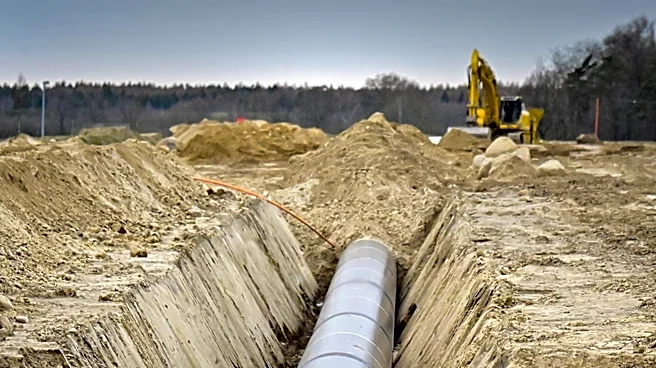
Daniel Chapo and Zimbabwean President Emmerson Mnangagwa broke ground on the Companhia do Pipeline Moçambique-Zimbabwe (CPMZ) expansion project. This initiative is projected to raise the annual pipeline capacity from 3 million to 5 million cubic meters by the end of 2027. The additional capacity is intended to enhance the supply of diesel, petrol, and jet fuel to Zimbabwe and other landlocked Southern African markets, including Malawi, Zambia, Botswana, and the Democratic Republic of Congo. The 294-kilometer CPMZ pipeline transports refined petroleum products from the Port of Beira to Feruka in Zimbabwe, serving as a crucial component of the Beira Corridor.
Why It's Important?
The expansion of the Beira-Harare fuel pipeline is a critical development for energy security and economic stability in Southern Africa. By significantly increasing fuel transport capacity, the project aims to alleviate supply constraints and reduce the cost of petroleum products for several landlocked countries in the region. This enhanced infrastructure will strengthen Mozambique's role as a strategic gateway for regional trade and deepen economic cooperation with Zimbabwe. For the U.S. and international businesses operating in Southern Africa, improved energy infrastructure can lead to more predictable supply chains, lower operational costs, and increased investment opportunities in sectors reliant on stable fuel access. The project also underscores a broader regional effort towards self-sufficiency and economic integration, potentially reducing reliance on more distant and costly supply routes. This initiative benefits consumers through potentially lower fuel prices and supports industrial growth by ensuring a more reliable energy supply.
What's Next?
The construction and commissioning of the expanded CPMZ pipeline are expected to proceed while the existing pipeline remains operational, ensuring no disruption to current fuel supplies. The project includes the establishment of new pumping stations in Nhamatanda and Messica. This expansion follows a previous upgrade in 2024 that increased capacity from 2 million to 3 million cubic meters. Further plans are being considered, including the potential replacement of the existing pipeline with a larger-diameter line to boost annual capacity to about 12 million cubic meters by 2050, addressing projected demand. Additionally, a possible extension of the Harare-Lusaka route into Zambia's Copperbelt is under consideration, which would further integrate regional fuel infrastructure and improve the movement of petroleum products across Southern Africa. These developments indicate a long-term commitment to enhancing regional energy infrastructure.
Beyond the Headlines
The expansion of the Beira-Harare fuel pipeline has deeper implications beyond immediate energy security. It represents a strategic move towards greater regional economic integration and resilience in Southern Africa. By strengthening intra-African infrastructure, the project reduces the vulnerability of landlocked nations to external supply shocks and geopolitical disruptions. This initiative could foster a more robust regional economy, encouraging cross-border trade and investment. Environmentally, while increasing fossil fuel transport, the project's long-term vision for expanded capacity and potential extensions highlights the ongoing reliance on traditional energy sources in the region, posing questions about the balance between energy security and climate change mitigation efforts. Socially, a more stable and affordable fuel supply can improve living standards, support agricultural productivity, and facilitate access to essential services in remote areas, contributing to overall regional development and stability.