





What's Happening?
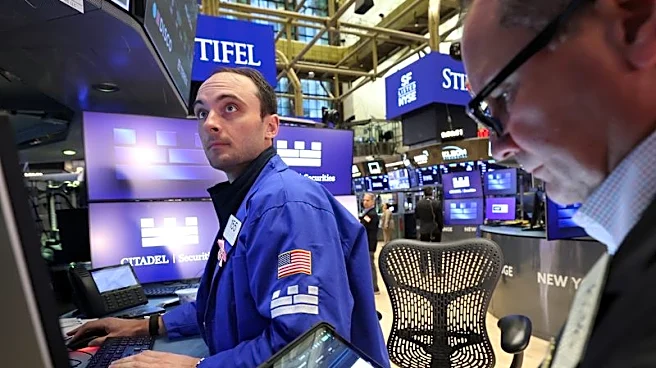
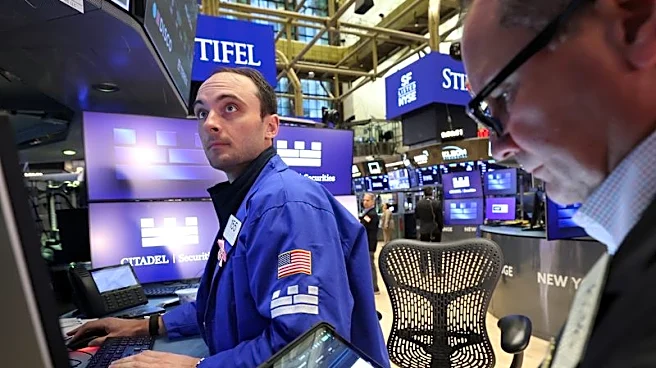
As the artificial intelligence (AI) trade shows signs of faltering, leading to increased market volatility and steep monthly losses for major U.S. stock indexes, analysts are recommending defensive stocks with minimal reliance on AI. The S&P 500, Dow
Jones Industrial Average, and Nasdaq Composite have all experienced significant declines in November 2026. In response, Piper Sandler upgraded Dollar General to overweight, citing its steady growth profile and potential for increased spending from its low-income customer base. Wolfe Research highlighted defense stocks like General Dynamics, RTX, Huntington Ingalls Industries, L3Harris Technologies, and Curtiss-Wright, noting their underperformance relative to the broader market has created opportunities. Morgan Stanley also expressed bullishness on insurance brokers such as Aon and Arthur J. Gallagher, emphasizing their strong earnings, low AI dependency, and regulatory barriers.
Why It's Important?
The shift in analyst recommendations from AI-dependent growth stocks to defensive sectors signals a potential change in market sentiment and investment strategy. This move is crucial for U.S. investors seeking to navigate an increasingly volatile market environment. The faltering AI trade suggests that the rapid growth seen in technology stocks may be unsustainable, prompting a re-evaluation of investment portfolios. Defensive stocks, characterized by stable earnings and less sensitivity to economic cycles, offer a potential safe haven during periods of uncertainty. This trend could lead to a reallocation of capital, benefiting sectors like retail, defense, and insurance, while potentially dampening further investment in speculative tech ventures. For the broader U.S. economy, a shift towards defensive investments could indicate a more cautious outlook on future growth prospects.
What's Next?
Investors are likely to continue re-evaluating their portfolios, potentially increasing allocations to defensive stocks that offer stability amidst market volatility. The performance of the recommended stocks—Dollar General, various defense contractors, and insurance brokers—will be closely watched as a barometer for this shift. If the AI trade continues to lose momentum, more analysts may follow suit in recommending non-AI-dependent sectors. This could lead to sustained interest and potentially higher valuations for companies with strong fundamentals and less exposure to speculative growth trends. The market will also be observing broader economic indicators and geopolitical developments, which could further influence investor confidence and the appeal of defensive assets.
Beyond the Headlines
The current market dynamics underscore a fundamental tension between innovation-driven growth and traditional value investing. The initial euphoria surrounding AI led to significant capital inflows into technology stocks, potentially creating an overvaluation bubble. The subsequent faltering of this trade highlights the importance of fundamental analysis and risk management, even in the face of transformative technologies. The appeal of defensive stocks, which are often less glamorous but provide consistent returns, reflects a return to more conservative investment principles. This shift could also have broader implications for corporate strategy, encouraging companies to focus on sustainable profitability and resilience rather than solely on rapid, often speculative, growth. The regulatory barriers in sectors like insurance, which limit AI adoption, paradoxically make them more attractive in a volatile market, illustrating how different industry structures respond to technological shifts.