








What's Happening?
ASML Holding has revised its 2026 revenue forecast upwards, driven by a surge in demand for artificial intelligence (AI) chip production equipment. The company reported second-quarter revenue of 9.33 billion euros ($10.9 billion), surpassing analyst expectations
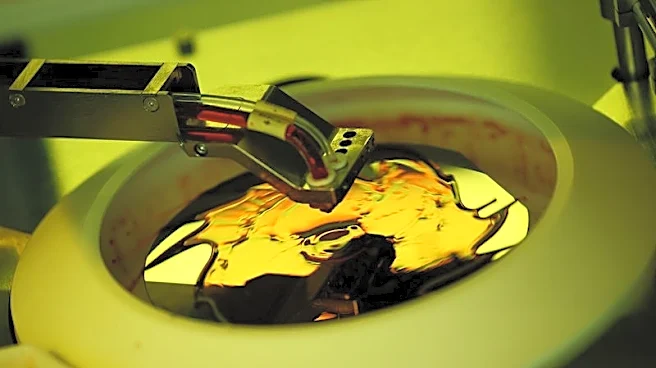
of 8.80 billion euros. Net income also exceeded forecasts, reaching 2.92 billion euros. ASML attributes this strong performance to the continued demand for its lithography systems used in AI chip manufacturing. The company now anticipates full-year 2026 net revenue to be between 43 billion euros and 45 billion euros, an increase from the previous forecast of 36 billion euros to 40 billion euros. To meet this demand, ASML plans to expand its production capacity for extreme ultraviolet (EUV) and deep ultraviolet (DUV) lithography systems by approximately 30% over the next two years.
Why It's Important?
The upward revision of ASML's revenue forecast highlights the growing importance of AI technology in the semiconductor industry. As AI applications expand, the demand for advanced chips is increasing, prompting major chipmakers like Taiwan Semiconductor Manufacturing, Samsung Electronics, SK Hynix, Micron Technology, and Intel to boost their production capacities. This trend underscores the critical role of companies like ASML in providing the necessary equipment to support this growth. The expansion of ASML's production capacity is likely to have significant implications for the semiconductor supply chain, potentially leading to increased competition and innovation in the sector.
What's Next?
ASML's plans to increase production capacity suggest a strategic move to capitalize on the burgeoning AI market. As chipmakers continue to expand their capabilities to meet AI-related demand, ASML's enhanced production capacity could position it as a key supplier in the industry. The company's focus on both EUV and DUV lithography systems indicates a comprehensive approach to addressing the diverse needs of its clients. This expansion may also prompt other equipment manufacturers to follow suit, potentially leading to a broader industry-wide increase in production capabilities.