





What's Happening?
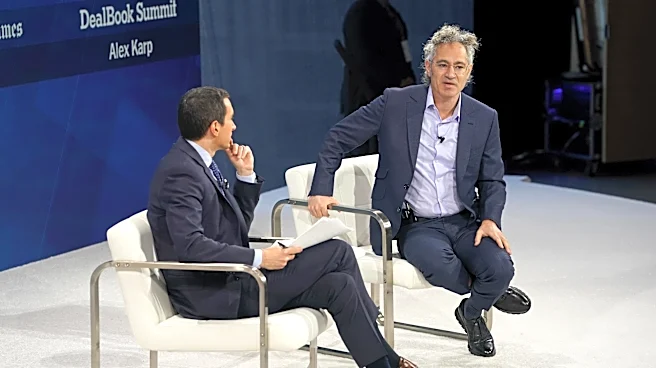
Leopold Aschenbrenner, a 25-year-old AI investor and founder of Situational Awareness, despite betting billions on AI's rapid economic transformation, advises his younger sisters to 'study the classics.' This counsel comes from a figure who predicts that
AI will accelerate significantly in the coming year, making modern life feel less 'normal' by 2027, and that 'agent swarms' of AI will soon perform most white-collar work. Aschenbrenner, a Columbia valedictorian who studied political economy and admires Edmund Burke, believes that human intellectual labor will become largely obsolete. His own fund experienced a record $30 billion loss, described as the largest in hedge-fund history, though it still manages over $10 billion and holds a significant stake in Anthropic. Despite his financial setbacks, his core belief in AI's transformative power remains, yet his advice for future generations points to a different kind of preparation.
Why It's Important?
Aschenbrenner's advice to study the classics, coming from a leading AI investor, is significant because it challenges the prevailing narrative that future success lies solely in STEM fields. This perspective suggests a growing recognition among some tech leaders that critical thinking, ethical reasoning, and a deep understanding of human nature—skills often cultivated through the humanities—will be crucial in an AI-dominated world. This could influence educational trends and career guidance in the U.S., potentially leading to a renewed emphasis on liberal arts education. It also highlights a potential societal shift where the value of human expertise might evolve, with AI handling technical tasks while humans focus on higher-order conceptual and ethical challenges. This debate has implications for workforce development, educational policy, and the future of human-AI collaboration.
What's Next?
The ongoing discussion among tech leaders about the value of humanities in the AI era is likely to continue, potentially influencing educational curricula and career counseling. As AI capabilities advance, there may be a growing demand for individuals who can understand and navigate complex ethical, social, and philosophical questions that AI presents. This could lead to increased enrollment in humanities programs or the integration of liberal arts principles into STEM education. The long-term impact on the job market will be closely watched, as the economy adapts to AI's increasing role in white-collar work. Aschenbrenner's own career trajectory, including his fund's planned relaunch, will also serve as a case study for how investors adapt to the volatile and rapidly changing AI landscape.
Beyond the Headlines
Aschenbrenner's personal background, including his great-grandmother's experiences through significant historical turbulence, informs his view that historical patterns of disruption will return, this time driven by AI. His admiration for Edmund Burke, who predicted the end of the French Revolution by a military strongman, suggests a concern that AI could lead to similar societal upheavals. This deeper implication touches on the ethical and governance challenges posed by advanced AI, raising questions about how societies will maintain stability and human agency in an era of unprecedented technological power. It underscores the need for robust ethical frameworks and thoughtful leadership to guide AI development and deployment, preventing potential negative societal outcomes.