




What's Happening?
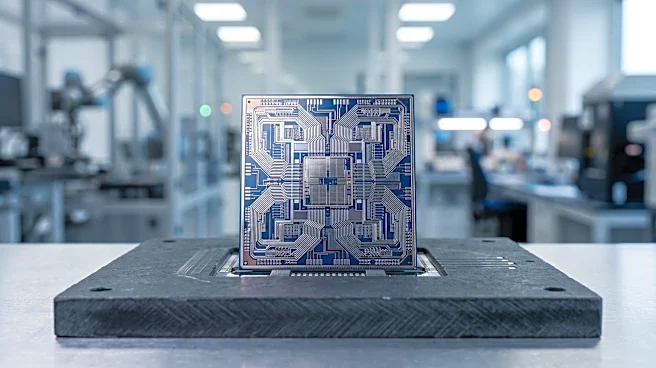
Naveen Rao's company, Unconventional AI, is employing a strategy of rapid chip iteration using 22nm process nodes to develop AI inference hardware. The company aims to tape out new chips approximately every three months, prioritizing speed and cost-effectiveness
over leading-edge performance. This approach allows for a tape-out to fab-out time of 40-50 days, significantly faster than the 130 days typically required for leading-edge processes. Mask costs for these 22nm chips are around $1.5 million, and verification processes are completed in hours. Rao, who previously founded Nervana (acquired by Intel) and MosaicML (acquired by Databricks), argues that current AI computing is energy-bound and that the traditional von Neumann architecture, which separates memory from compute, is inefficient for neural networks. Unconventional AI's core bet is to couple memory and compute, programming the machine with weights to exploit physical and temporal sparsity and locality. Their first silicon, a system of coupled oscillators, demonstrated significant energy efficiency, achieving about 900 nanojoules per image compared to approximately 50 millijoules per image for a GPU on small CIFAR-resolution images.
Why It's Important?
This rapid iteration strategy by Unconventional AI could significantly disrupt the AI hardware development landscape. By focusing on faster, cheaper production cycles with 22nm nodes, the company can quickly test and refine its architectural innovations, potentially accelerating the development of more energy-efficient AI inference solutions. The emphasis on coupling memory and compute directly addresses the energy consumption challenges in AI, which is crucial as AI models grow in complexity and deployment. If successful, this approach could lead to more accessible and scalable AI inference, reducing the operational costs for businesses and researchers relying on AI. The shift from selling hardware boxes to selling 'intelligence tokens' also signifies a potential change in the business model for AI compute, making AI capabilities more consumable as a service rather than requiring significant upfront hardware investment. This could lower barriers to entry for smaller companies and startups looking to leverage advanced AI, fostering broader innovation across various industries.
What's Next?
Unconventional AI plans to continue its three-month tape-out cadence, aiming to produce a sequence of chips that will close the gap to production inference economics. The company's first product is expected to be transformer-like and capable of sequence modeling, building on the initial success with diffusion models. Naveen Rao anticipates that Unconventional AI will primarily sell 'tokens' rather than physical hardware, aligning with a broader industry trend where customers prioritize intelligence delivery over hardware ownership. This business model will require the company to either operate or partner on data centers and ensure high-quality model distillation. The company recently acquired an Israeli firm, which has reportedly pulled in its product schedule. The long-term aspiration is to 'beat biology' in computational efficiency, a goal Rao expects to take five to ten years, relying on advancements in materials science and AI-accelerated physical AI. The market will be watching whether this rapid iteration and token-selling strategy can attract the necessary capital and model talent to scale effectively.
Beyond the Headlines
The strategy employed by Unconventional AI highlights a fundamental re-evaluation of AI hardware design and business models. The move away from the von Neumann architecture for AI-specific tasks suggests a paradigm shift towards specialized, energy-efficient computing tailored for neural networks. This could lead to a divergence in hardware development, with general-purpose computing maintaining traditional architectures while AI-specific hardware adopts more integrated memory-compute designs. The 'token' selling model also raises questions about data ownership, intellectual property, and the commoditization of intelligence. As AI becomes more integrated into daily life, the ethical implications of highly efficient, specialized AI hardware and the services built upon them will become increasingly important. The long-term goal of 'beating biology' in computational efficiency also touches upon profound philosophical questions about the nature of intelligence and the potential for artificial systems to surpass biological capabilities, potentially leading to new frontiers in scientific research and technological development.