






What's Happening?
Researchers at Stanford University and Stanford University School of Medicine in California have conducted a study, published in the journal npj Science of Food, to evaluate the capability of generative artificial intelligence (AI) in creating burger
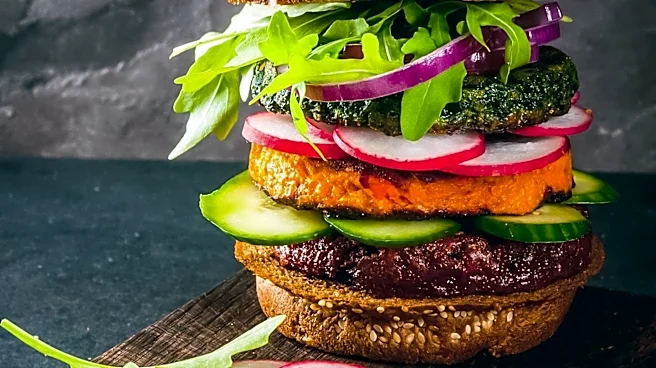
recipes. The AI model was trained on 2,216 human-written burger recipes from Food.com to learn patterns in human food preferences. The model then generated one million burger recipes, assessing them for novelty, predicted palatability, environmental impact, and nutritional quality. Five AI-generated burgers, designed for taste, nutritional quality, and environmental sustainability, were selected for a blinded sensory evaluation against a Big Mac reference. The study aimed to determine if AI could develop burgers that are delicious, environmentally sustainable, and nutritionally superior.
Why It's Important?
This research holds significant implications for the U.S. food industry and public health. The ability of generative AI to rapidly develop and optimize food recipes based on taste, nutrition, and environmental impact could revolutionize product development, offering a faster and more efficient alternative to traditional culinary expertise and repeated testing. This could lead to the creation of more sustainable and healthier food options that are also appealing to consumers, addressing critical issues like climate change, biodiversity loss, and malnutrition. For businesses, this technology could reduce R&D costs and accelerate market entry for innovative food products. Consumers stand to gain from a wider array of food choices that align with health and environmental values, potentially shifting dietary patterns towards more sustainable and nutritious options without compromising on taste.
What's Next?
The study's findings suggest that while AI can create burgers with comparable sensory acceptance and significantly improved environmental or nutritional profiles, no single tested burger achieved the highest scores across all three metrics simultaneously. Future research will need to address these trade-offs, potentially by refining AI models to better balance these competing objectives. Broader sensory evaluations and more comprehensive food-design models are also needed to establish the wider applicability of this AI approach beyond Western-style burger traditions. The researchers also highlighted the potential for AI to generate personalized burgers tailored to individual nutritional needs based on age, sex, body composition, and physical activity, though these were not included in the tasting. This opens avenues for highly customized food products in the future, moving towards precision nutrition.
Beyond the Headlines
The application of generative AI in food design extends beyond mere recipe creation; it touches upon fundamental questions about the future of food production and consumption. This technology could challenge traditional notions of culinary artistry by demonstrating that algorithms can effectively mimic and even innovate upon human preferences. Ethically, it raises questions about the authenticity and naturalness of AI-designed foods, and the potential for consumer acceptance of such products. Legally, it could necessitate new regulations regarding food labeling and intellectual property for AI-generated recipes. Culturally, it might lead to a re-evaluation of what constitutes 'good food,' moving towards a definition that incorporates environmental and nutritional metrics alongside taste. The study also implicitly highlights the limitations of current food systems in simultaneously delivering taste, nutrition, and sustainability, positioning AI as a potential disruptor to overcome these inherent challenges.