
What's Happening?
David Reger, CEO of German robotics company Neura Robotics, has stated that physical AI and robotics are on track to take over every physical task within the next two to five years. Reger emphasized the rapid
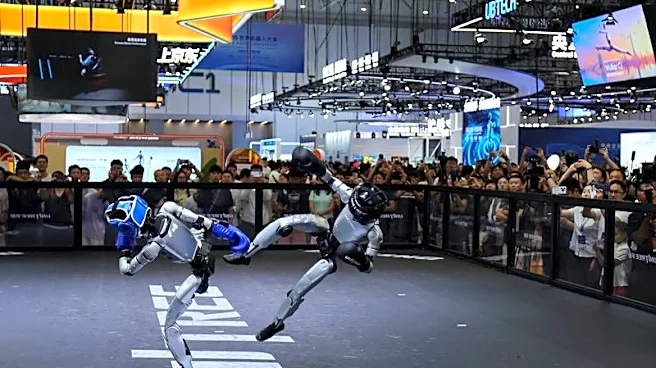
pace of development in physical AI, noting that he can train a robot for a task faster than he can train a human. While consumer-level robots are currently limited to devices like lawnmowers and vacuum cleaners, industrial robotics, particularly in assembly lines such as car manufacturing, are already demonstrating significant growth. The CEO's remarks highlight a future where humanoid robots could become prevalent across various sectors, including disaster response, manufacturing, and eldercare, with some companies, like Japan's Noetra, planning to deploy millions of humanoid robots by 2040.
Why It's Important?
This prediction by a leading robotics CEO carries significant implications for the U.S. labor market and economy. The widespread adoption of physical AI and robotics could lead to a substantial displacement of human labor in industries reliant on physical tasks, from manufacturing and logistics to healthcare and service sectors. While this could boost productivity and efficiency, it also poses challenges related to unemployment, workforce retraining, and economic inequality. Businesses might see reduced operational costs and increased output, but policymakers will need to address the societal impact, potentially through new social safety nets or educational reforms focused on skills that complement AI and robotics. The shift could also accelerate the U.S.'s competitive edge in advanced manufacturing if investments in robotics technology and infrastructure are prioritized.
What's Next?
The coming years are likely to see increased investment and innovation in physical AI and robotics, driven by companies like Neura Robotics and Noetra. We can anticipate a surge in the development of more accessible and affordable humanoid robots, as exemplified by Nor Robotics' sub-$2,000 Nori A3 robot designed for home use. This will push the boundaries of what robots can do, from household chores to complex industrial operations. Governments and educational institutions will face pressure to adapt to these technological advancements, potentially by funding research, developing new curricula for AI and robotics, and implementing policies to manage the transition of the workforce. The ethical and societal implications of widespread robot integration will also become a more prominent discussion point, requiring careful consideration from various stakeholders.
Beyond the Headlines
The rapid advancement of physical AI and robotics raises profound ethical and philosophical questions about the future of human labor and societal structure. If robots can perform all physical tasks more efficiently than humans, what becomes the primary role of human beings in the economy? This shift could redefine the concept of work, leisure, and economic value. There are also concerns about the potential for increased automation to exacerbate existing social inequalities, as those without the skills to manage or develop these technologies might be left behind. Furthermore, the integration of advanced robots into daily life, both industrially and domestically, will necessitate new legal frameworks concerning liability, safety, and the rights of both humans and potentially, advanced AI entities. The cultural impact, including how humans interact with and perceive increasingly intelligent machines, will also be a significant area of exploration.