

What's Happening?
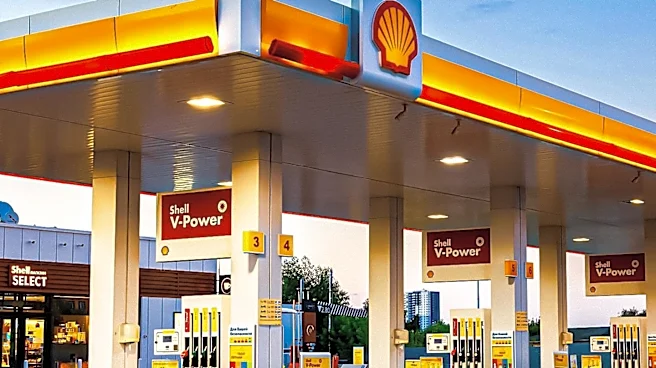
Shell plc announced on November 26, 2026, that it purchased a significant number of its own shares for cancellation as part of an ongoing share buy-back program. The purchases were executed across multiple trading venues, including the London Stock Exchange
(LSE), Chi-X (CXE), BATS (BXE), XAMS, CBOE DXE, and TQEX. On this date, Shell plc acquired 761,590 shares on the LSE at a volume-weighted average price of £36.0765, 273,327 shares on Chi-X (CXE) at £36.0726, and 175,083 shares on BATS (BXE) at £36.0914. Additionally, the company purchased shares on European exchanges, including 453,606 shares on XAMS at €43.2571, 180,346 shares on CBOE DXE at €43.2475, and 12,059 shares on TQEX at €43.1974. These transactions are part of a broader buy-back initiative announced on October 29, 2026, which is being managed by BNP Paribas and Natixis, making independent trading decisions on behalf of Shell plc.
Why It's Important?
Share buy-back programs, such as the one undertaken by Shell plc, are significant for investors as they can positively impact shareholder value. By reducing the number of outstanding shares, a company can increase its earnings per share (EPS), which often leads to a higher stock price. This move signals confidence from Shell's management in the company's financial health and future prospects, potentially attracting more investors. For U.S. investors holding Shell plc shares, either directly or through funds, this action could contribute to the appreciation of their investment. Furthermore, the program's adherence to EU MAR and UK MAR regulations highlights the company's commitment to regulatory compliance in its financial operations, which is crucial for maintaining investor trust and market stability across international financial markets.
What's Next?
The current share buy-back program by Shell plc is scheduled to continue, with BNP Paribas and Natixis making trading decisions independently until January 29, 2027. Investors and market observers will be closely watching for further announcements regarding the progress and completion of this program. The company's ongoing financial performance and any future strategic decisions related to capital allocation will likely be influenced by the success of this buy-back. The program's impact on Shell's stock price and its overall market valuation will be a key indicator of its effectiveness. Future buy-back initiatives or dividend policies could also be influenced by the outcomes of this current program, shaping the company's long-term financial strategy.
Beyond the Headlines
The decision by Shell plc to engage in a substantial share buy-back program reflects a broader trend among large corporations to return capital to shareholders, often in lieu of or in addition to dividend payments. This strategy can be viewed as a way for companies to optimize their capital structure and enhance shareholder returns, particularly when they have strong cash flows and limited immediate investment opportunities. However, critics sometimes argue that buy-backs can divert funds that could otherwise be used for long-term investments in research and development, capital expenditures, or employee wages, potentially impacting future growth. For Shell, an energy and petrochemical company, such capital allocation decisions are particularly scrutinized given the global push towards renewable energy and sustainability, raising questions about the balance between short-term shareholder returns and long-term strategic investments in energy transition.