







What's Happening?
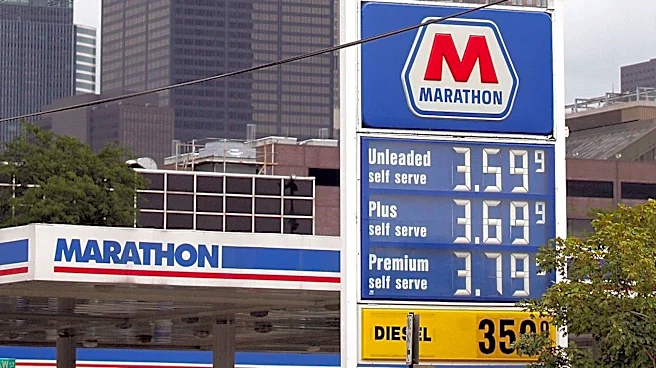
Marathon Petroleum Corporation (MPC) announced a substantial net income of $7.4 billion for the third quarter of 2026, a significant increase from $1.4 billion in the same period last year. The company's earnings per share rose to $26.59, with adjusted
net income reaching $7.5 billion, or $26.93 per share. Adjusted EBITDA for the quarter was $11.7 billion, up from $3.2 billion year-over-year. The Refining & Marketing unit saw its adjusted EBITDA jump from $1.8 billion to $9.9 billion, driven by higher crack spreads and full operational capacity, achieving a $34.15 per barrel margin. The Midstream segment also contributed with $1.9 billion in EBITDA. Additionally, Renewable Diesel operations shifted from losses to a $254 million boost. Concurrently, MPC and MPLX LP have entered a definitive agreement to divest their St. Paul Park, Minnesota, and Mandan, North Dakota, refineries, along with related midstream assets, to CVR Energy, Inc. The total purchase price for this transaction is $4.2 billion, plus inventory value, with MPC receiving $3.45 billion for the refining assets and MPLX receiving $750 million for the midstream assets. This divestiture is part of MPC's strategy to reallocate capital to higher-value opportunities, particularly in the Gulf Coast markets.
Why It's Important?
This significant profit surge for Marathon Petroleum Corporation underscores the current strength in the refining sector, driven by favorable market conditions and robust crack spreads. The company's ability to generate such substantial earnings directly impacts its shareholders, as evidenced by the return of $3.3 billion in capital, a 10% increase in quarterly dividends, and a 12.5% gain in MPLX distributions. The strategic divestiture of the Mid-Con assets for $4.2 billion signals a calculated shift in MPC's operational focus towards more lucrative regions like the Gulf Coast. This move is expected to enhance the company's long-term profitability and efficiency by allowing reinvestment in high-return refinery upgrades. For the broader U.S. energy market, this transaction indicates a dynamic environment where companies are optimizing their portfolios to maximize value. CVR Energy, the acquirer, will significantly expand its crude throughput capacity, extending its refining footprint into the Upper Midwest and Northern Great Plains, which could lead to increased competition and efficiency in those regional transportation-fuels markets. The proceeds from the sale will also support MPLX's growth in the Permian and Marcellus basins, further impacting U.S. energy infrastructure development.
What's Next?
Marathon Petroleum anticipates closing the divestiture of its St. Paul Park and Mandan refineries to CVR Energy by year-end, subject to regulatory approvals. The proceeds from this sale are slated for redeployment primarily into Gulf Coast operations and to support MPLX's growth initiatives in the Permian and Marcellus basins, indicating a strategic pivot towards these high-value regions. MPC plans to continue its share repurchase strategies, with an additional $5 billion authorization, reinforcing its commitment to shareholder returns. The company forecasts stable refining operating costs in the near term, though it acknowledges potential volatility from crude oil prices and regulatory changes. CVR Energy expects to realize approximately $70 million annually in run-rate synergies from the acquisition, primarily through reductions in selling, general, and administrative costs, as well as commercial and operational improvements. This acquisition will also expand CVR Energy's fuels marketing platform, potentially improving margin optimization and providing additional blending capacity to reduce exposure to volatile Renewable Identification Number (RIN) compliance costs. The market will closely watch how these strategic shifts impact MPC's future performance and the competitive landscape of the U.S. refining industry.
Beyond the Headlines
The substantial profit increase and strategic asset divestiture by Marathon Petroleum highlight a broader trend within the U.S. energy sector: a continuous re-evaluation and optimization of asset portfolios in response to evolving market dynamics and regulatory pressures. The focus on high-value regions like the Gulf Coast and growth in key basins such as Permian and Marcellus reflects an industry-wide drive for efficiency and profitability. This strategic realignment could lead to a more concentrated and specialized refining landscape, potentially impacting regional fuel prices and supply chains. The emphasis on returning value to shareholders through dividends and buybacks also signals confidence in the company's financial health and future outlook, which could influence investor sentiment across the energy sector. Furthermore, the acquisition by CVR Energy, expanding its footprint into the Upper Midwest, suggests a strategic move to diversify crude oil sources and product distribution channels, potentially enhancing energy security and resilience in those regions. The long-term implications include potential shifts in environmental compliance strategies as companies adapt their operations to new regional focuses and regulatory frameworks.