







What's Happening?
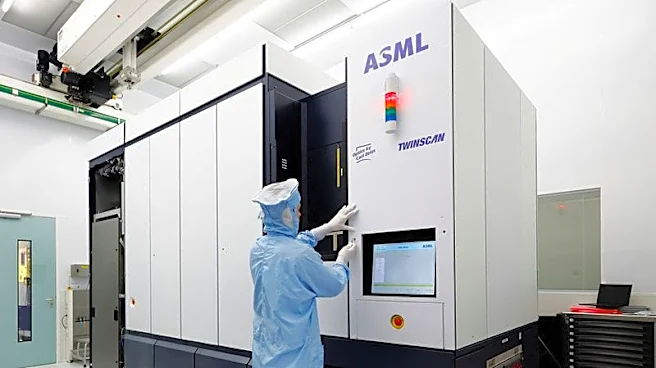
ASML, a leading Dutch lithography equipment manufacturer, has raised its revenue forecast for 2026, citing strong demand for semiconductor manufacturing equipment used in AI chip production. The company now anticipates net revenue between €43 billion
and €45 billion, up from a previous estimate of €36 billion to €40 billion. This adjustment follows a robust second-quarter performance, where ASML reported revenues of €9.33 billion, surpassing analyst expectations. The company plans to expand its manufacturing capacity for both EUV and DUV lithography systems by 30% annually over the next two years to meet growing demand. Despite U.S.-led export restrictions, ASML expects China to account for about 20% of its sales in 2026, continuing to supply less advanced DUV equipment to Chinese customers.
Why It's Important?
ASML's revised forecast underscores the growing importance of AI-driven semiconductor manufacturing, which is crucial for technological advancements in various sectors, including computing and smartphones. The company's expansion plans reflect a broader industry trend towards increasing production capabilities to meet the surging demand for AI chips. This development is significant for the U.S. and global tech industries, as it highlights the competitive dynamics in semiconductor manufacturing, particularly between the U.S. and China. The ongoing export restrictions and potential new U.S. legislation could impact ASML's business operations, emphasizing the geopolitical complexities in the tech supply chain.
What's Next?
ASML's decision to boost production capacity suggests a strategic move to capitalize on the AI chip demand surge. The company's future performance will likely be influenced by geopolitical factors, including U.S. export policies and China's technological ambitions. Stakeholders in the semiconductor industry will be closely monitoring these developments, as they could affect global supply chains and market dynamics. Additionally, ASML's collaboration with major tech companies like Intel, which is using its High-NA EUV lithography system, indicates potential advancements in semiconductor technology.