






What's Happening?
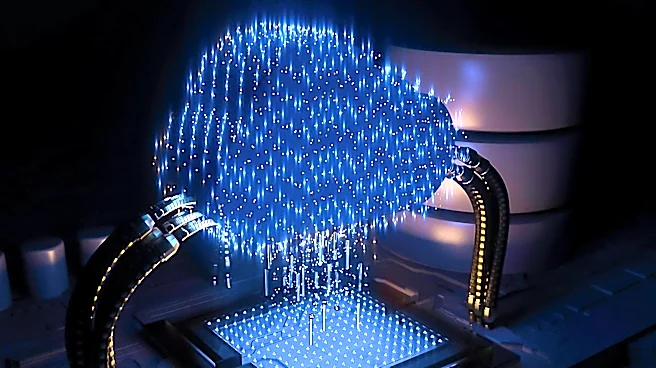
German startup Saxon Q has introduced the world's first portable diamond-powered quantum computer that operates at room temperature. This innovative system does not require cryogenic cooling, making it more accessible and easier to deploy in conventional
computing environments. The quantum computer uses nitrogen-vacancy defects in synthetic diamonds to function as qubits, which are manipulated using lasers and microwave pulses. The current model supports up to 128 qubits, with plans to expand to 512 qubits next year and eventually exceed 10,000 qubits by 2030. The system's single-qubit fidelity has reportedly reached 99.98%, although these figures have not yet been independently verified.
Why It's Important?
The development of a portable quantum computer that operates at room temperature represents a significant advancement in quantum technology. This innovation could reduce the reliance on cloud-based quantum services, particularly for applications where communication delays are critical, such as robotics and autonomous driving. The ability to deploy quantum computers locally without the need for extensive cooling infrastructure could make quantum computing more accessible to a wider range of industries and research fields. However, challenges remain in scaling the technology to support larger numbers of qubits and improving chip density. The success of this technology could pave the way for more practical and widespread use of quantum computing in various applications.
What's Next?
Saxon Q plans to continue developing its quantum computing technology, with a focus on increasing the number of qubits and improving system stability. The company aims to release a 512-qubit system next year and has a long-term goal of exceeding 10,000 qubits by 2030. As the technology matures, it is expected to find applications in fields that require high computational power and precision, such as materials science, pharmaceuticals, and energy. Researchers will continue to explore the potential of nitrogen-vacancy technology and other quantum approaches to enhance the capabilities of quantum computers. The ongoing development of this technology will likely lead to new breakthroughs and applications in the coming years.