








What's Happening?
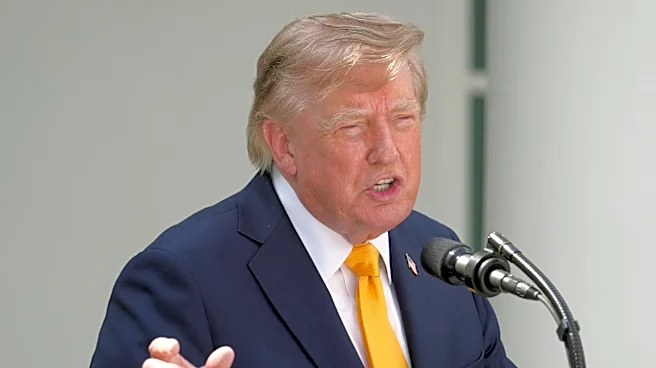
President Trump announced a threat to impose a 50% tariff on all Canadian cars, trucks, automotive parts, and steel, effective January 1, 2027. This announcement, made via social media, follows earlier executive orders signed on July 20 for tariffs up
to 50% on various Canadian goods including lumber, concrete, dairy, and technology. The latest threat emerged after trade talks with Canada abruptly ended. Canadian Prime Minister Mark Carney has accused the Trump administration of attempting to dismantle Canada's auto industry and has indicated that Canada will not back down, announcing retaliatory tariffs on American goods such as steel, dairy, and electronics. The proposed tariffs are seen by some as a tactic to annex Canada rather than a fair trade measure, especially given the inclusion of demands related to French language and culture during negotiations.
Why It's Important?
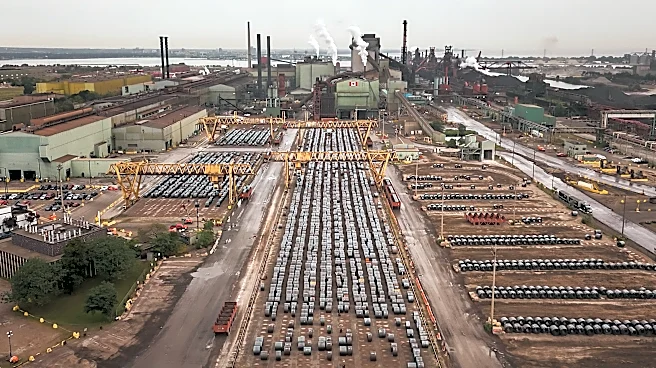
The imposition of a 50% tariff on Canadian automotive imports would have significant repercussions for the U.S. auto industry and consumers. According to Erin Keating, executive analyst for Cox Automotive, the impact would extend far beyond Canadian assembly plants, affecting the integrated regional manufacturing system built over decades under agreements like NAFTA and USMCA. Major U.S. automakers like General Motors and Ford import tens of thousands of vehicles from Canada, including popular models and parts. Sam Fiorani, vice president of Global Vehicle Forecasting for AutoForecast Solutions, notes that Honda, Toyota, and Lexus also build a substantial number of vehicles in Canada, with over 600,000 units sold in the U.S. annually. Beyond new car sales, increased tariffs on auto parts would lead to higher repair and insurance costs for all American car owners, regardless of whether they purchase a new vehicle, placing additional financial strain on consumers.
What's Next?
The immediate future hinges on whether President Trump's threat of a 50% tariff on Canadian automotive products will be implemented as stated on January 1, 2027, or if it will be altered or withdrawn. The Canadian government, led by Prime Minister Mark Carney, has already announced retaliatory tariffs on American goods, indicating a potential escalation of trade tensions. Stakeholders in the U.S. automotive industry, including manufacturers and consumers, will be closely monitoring developments, as the tariffs could significantly disrupt supply chains, increase vehicle prices, and raise maintenance costs. The possibility of legal challenges or further negotiations remains, given the history of trade policy under the Trump administration. The outcome will determine the extent of the economic impact on both sides of the border and the future of the integrated North American automotive market.
Beyond the Headlines
This tariff threat highlights deeper issues concerning international trade relations and the stability of established economic partnerships. The integrated nature of the North American automotive industry, fostered by agreements like USMCA, means that tariffs on one country's products can have a cascading effect across the entire supply chain, impacting jobs, investment, and consumer prices in all participating nations. The inclusion of demands related to French language and culture during trade talks suggests that the dispute extends beyond purely economic considerations, touching upon national sovereignty and cultural identity. Such aggressive trade tactics could lead to a broader re-evaluation of international trade agreements and potentially encourage other nations to adopt protectionist measures, fragmenting global markets and increasing economic uncertainty. The long-term implications could include a shift towards more localized manufacturing, higher production costs, and reduced consumer choice.