




What's Happening?
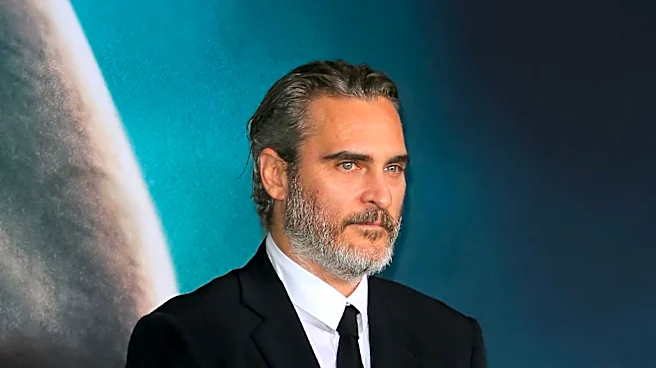
In 2008, Joaquin Phoenix, an actor twice nominated for an Oscar, declared his retirement from his film career. He stated his intention to dedicate himself to hip-hop. This announcement was part of a larger, elaborate hoax orchestrated by Phoenix and director
Casey Affleck. The public and media widely believed Phoenix was genuinely transitioning to a music career and struggling with substance abuse, with reports even detailing his apparent decline. However, in September 2010, Affleck revealed that Phoenix's transformation and subsequent public struggles were entirely fabricated for a documentary. The purpose of this deception was to demonstrate how easily even incredible falsehoods could be presented as truth in the media. The documentary, titled 'I'm Still Here,' featured various public figures, including Jack Nicholson, Billy Crystal, and Danny Glover, as unwitting participants in the hoax.
Why It's Important?
This event is significant as it highlighted the susceptibility of media and the public to fabricated narratives, even when they appear extreme. Phoenix's elaborate hoax, which involved a public persona shift and simulated personal struggles, served as a critical commentary on media sensationalism and the consumption of celebrity news. It demonstrated how easily public perception can be manipulated and how difficult it can be to discern truth from fiction in the age of constant media coverage. The incident also sparked discussions about the ethics of such performance art and its impact on the public's trust in news reporting. For the entertainment industry, it raised questions about the boundaries between an actor's public and private life and the lengths to which artists might go for a creative project.
What's Next?
Following the revelation of the hoax in 2010, Joaquin Phoenix resumed his acting career, demonstrating that the 'retirement' was indeed part of the performance. The documentary 'I'm Still Here,' which chronicled the two-year deception, was released and provided insight into the motivations and execution of the project. The incident has since become a notable case study in media studies and performance art, often referenced when discussing media literacy and the nature of celebrity. Phoenix has continued to star in critically acclaimed films, earning further accolades, suggesting that the temporary departure and the subsequent reveal did not permanently damage his career, but rather added a unique chapter to his public narrative.
Beyond the Headlines
The Joaquin Phoenix hoax delves into deeper implications concerning the nature of reality and perception in the digital age. It challenged the audience to question the authenticity of what they consume through media, particularly regarding celebrity lives. The project can be viewed as a meta-commentary on the performative aspects of fame and the public's insatiable appetite for dramatic narratives. Ethically, it sparked debate about the responsibility of artists and media outlets in presenting information. Culturally, it reflected a growing skepticism towards media narratives and a heightened awareness of how easily public figures can construct and deconstruct their images. This event underscored the idea that even seemingly genuine public struggles can be meticulously crafted performances, blurring the lines between art and life.