






What's Happening?
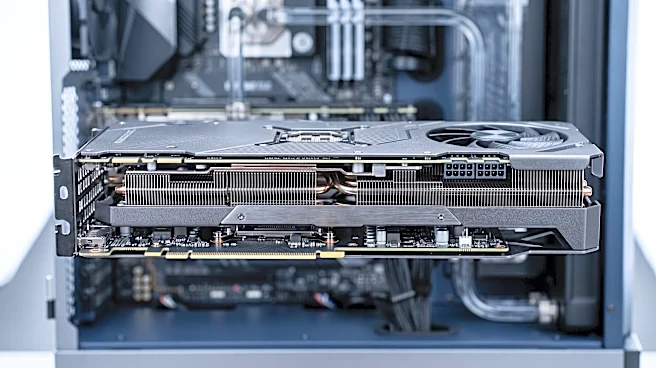
Chinese tech companies have reportedly purchased more than 1 million Nvidia gaming and workstation GPUs within a single year to address a significant shortfall in AI computing power. This buying spree highlights China's continued reliance on U.S. AI hardware,
despite its national strategy to boost domestic AI chip production. Industry insiders indicate that China's domestic AI chip manufacturing, while doubling this year, cannot meet the demand, with a projected shortfall of nearly 1.5 million chips against a demand exceeding 5 million. To compensate, Chinese firms are repurposing Nvidia's export control-compliant gaming and workstation processors, such as the RTX Pro 6000D, RTX Pro 5000, and RTX 5090, for simpler AI workloads like prefilling. The demand is partly driven by Nvidia's CUDA software, which remains more favorable than alternatives.
Why It's Important?
This development underscores the complex impact of U.S. export controls on the global AI chip market and China's technological ambitions. While the controls aim to limit China's access to advanced AI capabilities, they have inadvertently created a secondary market for less powerful, compliant Nvidia GPUs, which are then repurposed for AI tasks. This situation highlights the ingenuity of Chinese companies in circumventing restrictions and maintaining their AI development momentum. For the U.S., it reveals the challenges of implementing effective technology controls in a globally interconnected industry. The increased demand for gaming GPUs for AI purposes also affects the consumer market, potentially driving up prices and limiting availability for gamers. Furthermore, it emphasizes the enduring importance of Nvidia's software ecosystem, particularly CUDA, as a key differentiator.
What's Next?
The trend of repurposing gaming and workstation GPUs for AI in China is likely to continue as long as U.S. export controls on advanced AI chips remain in place and domestic production cannot meet demand. Nvidia may need to assess the implications of this trend on its product strategy and market segmentation. The enthusiast gaming GPU market could continue to experience price volatility and supply shortages due to this unexpected demand. China will likely intensify its efforts to develop more powerful domestic AI chips and alternative software ecosystems to reduce its reliance on U.S. technology. This dynamic could lead to further innovation in both compliant hardware solutions and domestic AI infrastructure within China, potentially creating a more bifurcated global AI hardware market.
Beyond the Headlines
The repurposing of gaming GPUs for AI tasks reveals a deeper narrative about resourcefulness and adaptation in the face of technological restrictions. It highlights that the line between consumer-grade and professional-grade hardware can blur when strategic imperatives are strong enough. This practice also raises questions about the long-term sustainability and efficiency of using less optimized hardware for demanding AI workloads. While it provides a temporary solution for China, it may not be as cost-effective or energy-efficient as purpose-built AI accelerators. Furthermore, this situation underscores the critical role of software ecosystems, like Nvidia's CUDA, in driving hardware adoption, as developers often prefer platforms with established tools and communities, even if the underlying hardware is not ideal. This could influence future strategies for both hardware manufacturers and software developers in the AI space.