
What's Happening?
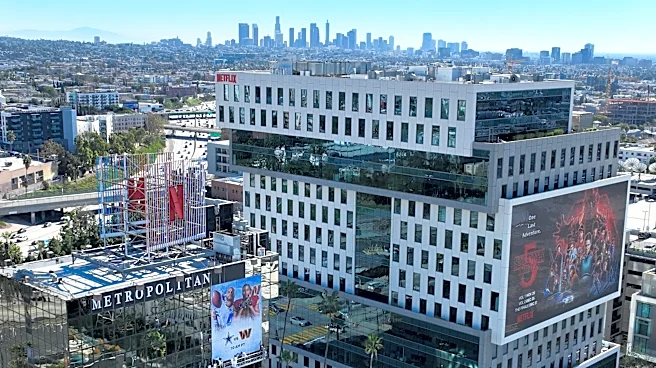
Netflix has finalized the acquisition of the historic Radford Studio Center in Studio City, California, for $380 million. The deal, which followed months of negotiations, was made directly with lenders
led by Goldman Sachs, preventing a scheduled auction of the property. The 55-acre complex, established in 1928, boasts 22 soundstages, over 210,000 square feet of office space, and nearly 173,000 square feet of support facilities. This acquisition marks a significant expansion of Netflix's physical presence in Los Angeles. The company plans extensive renovations for the studio, which has a rich history as a production hub for classic television series such as 'Gunsmoke,' 'Gilligan’s Island,' and 'Seinfeld.' Netflix co-CEOs Ted Sarandos and Greg Peters emphasized that this purchase represents a substantial new investment in California's film industry and a commitment to supporting local workers.
Why It's Important?
This acquisition is a strategic move for Netflix, solidifying its production capabilities and long-term commitment to content creation in the U.S. By owning a major studio lot, Netflix gains greater control over its production pipeline, potentially reducing costs associated with leasing studio space and ensuring availability for its growing slate of original programming. This investment comes at a time of uncertainty for the entertainment industry, with recent layoffs and shifts in content strategy. Netflix's decision to invest heavily in physical infrastructure in Los Angeles signals confidence in the future of Hollywood production and its role within it. The planned renovations will modernize an iconic space, transforming it into a dedicated production hub for Netflix, which could attract top talent and further enhance its content quality. This move also reinforces Netflix's commitment to California, a key state for film and television production, by creating jobs and supporting the local economy.
What's Next?
Netflix will proceed with significant renovations to the Radford Studio Center, aiming to modernize the facilities and integrate them into its production ecosystem. Current tenants of the studio will be able to continue their operations in the short term, and Netflix will maintain its leased offices on Sunset Boulevard until approximately the end of 2031. The company has engaged ZVantage and Cinelease to manage the transition and enhance production services, ensuring operational continuity. This acquisition is expected to strengthen Netflix's ability to produce a high volume of original content efficiently, potentially leading to more diverse and high-quality productions. The move could also influence other streaming services to consider similar investments in physical production assets, further shaping the landscape of content creation in Hollywood. The long-term impact will likely be a more vertically integrated production model for Netflix, giving it a competitive edge in the streaming wars.
Beyond the Headlines
The acquisition of Radford Studio Center by Netflix represents a broader trend in the entertainment industry where major content distributors are increasingly becoming content producers and owners of the underlying infrastructure. This vertical integration allows companies like Netflix to exert greater control over the entire content lifecycle, from creation to distribution. It also reflects a strategic shift away from solely relying on third-party studios, providing a more stable and dedicated environment for their productions. Furthermore, this investment in a historic studio lot underscores the enduring importance of physical production spaces in an increasingly digital world. While streaming has revolutionized content delivery, the need for soundstages, offices, and support facilities remains critical for large-scale film and television production. This move by Netflix could also be seen as a response to the competitive pressures in the streaming market, where owning and controlling production assets can be a significant differentiator.