





What's Happening?
Economists utilize various indicators to determine the state of the U.S. economy, particularly in identifying recessions. A common definition of a recession is two consecutive quarters of negative GDP growth. However, the National Bureau of Economic Research
(NBER) typically declares a recession's start months after its peak, using a suite of indicators rather than a single metric. Economic indicators are categorized as leading, coincident, or lagging. Leading indicators, such as declining initial jobless claims and rising building permits, change direction before the economy turns, offering early warnings. Coincident indicators, including real GDP, nonfarm payrolls, and industrial production, move in lockstep with the economy. Lagging indicators, like the unemployment rate and the Consumer Price Index (CPI) for services, change after the economy has already turned, confirming established trends. For instance, a rising unemployment rate is a lagging indicator that confirms a downturn has persisted. The stock market's record valuation does not necessarily signal an impending recession, as noted by some sources. The systematic study of these indicators gained prominence after the Great Depression, highlighting the need for reliable signals to anticipate economic changes.
Why It's Important?
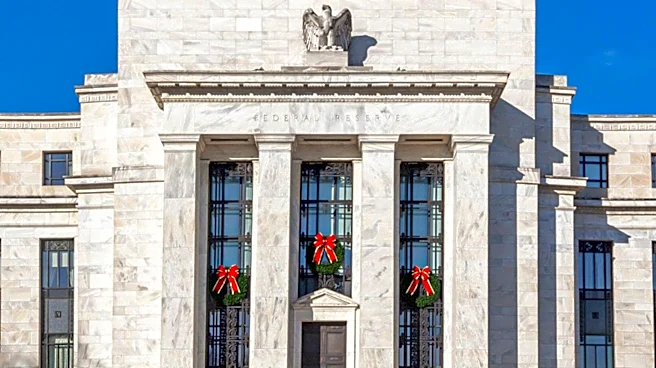
Understanding these economic indicators is crucial for U.S. industries, policymakers, and investors. Accurate interpretation of leading indicators allows businesses to adjust strategies, such as inventory management or hiring plans, in anticipation of economic shifts. For investors, recognizing these signals can inform asset allocation decisions, prompting a rotation from defensive positions to early-cycle beneficiaries like financials or consumer discretionary stocks as a trough approaches. Policymakers, including the Federal Reserve, rely on these indicators to make informed decisions regarding interest rates and monetary policy, aiming to stabilize the economy. Misinterpreting these signals, particularly by focusing solely on lagging indicators, can lead to delayed responses and exacerbate economic downturns. The historical context shows that while leading indicators may turn up, lagging indicators can still appear dire, creating a complex picture for those trying to navigate economic cycles. The ability to differentiate between these indicators helps stakeholders make timely and effective decisions, mitigating potential losses and capitalizing on emerging opportunities.
What's Next?
The ongoing monitoring of these economic indicators will continue to be paramount for assessing the U.S. economic trajectory. As leading indicators like initial jobless claims and building permits are observed, they will provide early insights into potential shifts. The NBER will eventually provide official declarations of recessionary periods, but these are retrospective. Therefore, real-time analysis of the interplay between leading, coincident, and lagging indicators will guide immediate policy and business decisions. For instance, if leading indicators continue to show an upward trend while lagging indicators remain challenging, it could signal an impending recovery, prompting a gradual shift in investment strategies and policy adjustments. Conversely, a decline in leading indicators would warrant increased caution and potentially proactive measures from the Federal Reserve and other governmental bodies to prevent or mitigate a downturn. The focus will remain on identifying patterns that align with historical economic cycles to anticipate future conditions.
Beyond the Headlines
Beyond the immediate implications, the reliance on economic indicators highlights a broader challenge in economic forecasting: the inherent difficulty in predicting future events with certainty. While sophisticated models and data collection have evolved significantly since the Great Depression, the economy remains subject to unforeseen shocks and complex interactions. The existence of 'weird' economic indicators, such as the 'Men's Underwear Index' or the 'Lipstick Index,' though not formally used by institutions like the Federal Reserve, underscores the human tendency to seek intuitive, albeit unconventional, signals in times of uncertainty. This also points to the psychological aspect of economic cycles, where consumer confidence and spending habits can be influenced by a myriad of factors, some of which are not captured by traditional metrics. The continuous refinement of economic models and the integration of diverse data points reflect an ongoing effort to reduce the 'perilous cost of flying blind' and improve the resilience of the U.S. economy against future downturns.