


What's Happening?
SoftBank is reportedly in negotiations to purchase a majority stake in 1X Technologies, an OpenAI-backed humanoid robotics startup, for approximately $6 billion. This potential acquisition would significantly expand SoftBank's presence in the robotics sector,
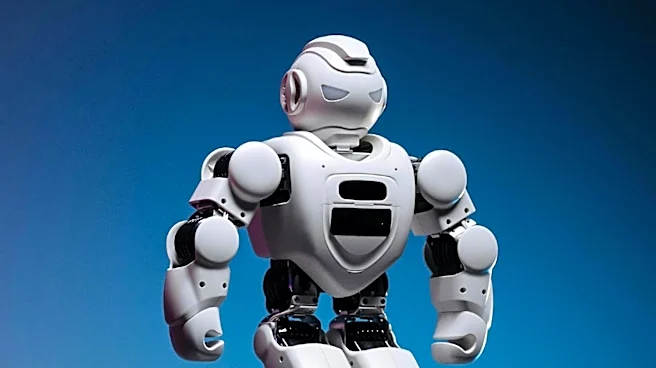
adding humanoid technology to its existing portfolio which includes industrial arms and autonomous construction equipment. 1X Technologies, originally founded in Norway in 2014 as Halodi Robotics, rebranded in 2023 to focus on androids designed for human environments. The company has developed two main models: EVE, a wheeled android for commercial use, and NEO, a bipedal humanoid intended for domestic applications. 1X Technologies gained significant attention after the OpenAI Startup Fund led a $23.5 million Series A2 funding round in March 2023. The company has also established a manufacturing facility in California with the capacity to produce 10,000 NEO units in its first year, with a target of 100,000 units by the end of 2027. This move aligns with SoftBank founder Masayoshi Son’s broader strategy to invest in physical AI.
Why It's Important?
This potential acquisition underscores a growing trend in the technology sector where major investment firms are increasingly focusing on physical AI, viewing it as a key driver for future returns. For SoftBank, securing a majority stake in 1X Technologies would solidify its full-stack robotics strategy, integrating humanoids alongside its industrial robotics and construction automation assets. This diversification could position SoftBank as a dominant player across various segments of the robotics market. For 1X Technologies, the investment from SoftBank would provide substantial capital and strategic backing, potentially accelerating the development and commercialization of its humanoid robots. The involvement of OpenAI as an early backer of 1X also highlights the convergence of AI model development with advanced robotics, suggesting a future where AI-powered humanoids become more prevalent in both commercial and domestic settings. This development could also intensify competition in the humanoid robotics market, particularly with companies like Tesla and its Optimus robot.
What's Next?
If the deal materializes, SoftBank will gain control of a humanoid robotics company with a strong connection to OpenAI, potentially leveraging this relationship for further technological advancements. 1X Technologies is already accepting reservations for its NEO robot, with U.S. deliveries anticipated to commence in 2026 from its California manufacturing base. The immediate challenge for 1X will be to transition its technology from demonstrations to reliable, scalable commercial deployment, especially given that early units of NEO will not be fully autonomous and may require remote human assistance for complex tasks. The success of this venture will depend on SoftBank's ability to transform early enthusiasm into a functional household product at scale. This acquisition could also spur further investment and innovation in the humanoid robotics space, as other companies and investors seek to capitalize on the perceived market potential.
Beyond the Headlines
The reported $6 billion valuation for 1X Technologies, despite its flagship product not yet reaching customers, reflects a significant investor confidence in the future of humanoid robotics and physical AI. This valuation, even if a markdown from previous aspirations, indicates a belief that these robots will eventually move beyond niche applications into widespread commercial and domestic use. The ethical and societal implications of deploying humanoids for household chores and other tasks will become increasingly relevant. Questions regarding job displacement, data privacy, and the integration of autonomous entities into daily life will need to be addressed as these technologies mature. Furthermore, the strategic alignment between SoftBank and an OpenAI-backed company suggests a future where the development of advanced AI models and sophisticated robotic hardware are inextricably linked, potentially leading to rapid advancements and unforeseen applications.