


What's Happening?
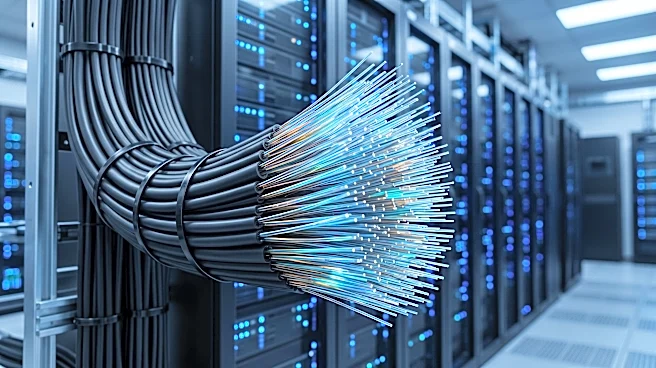
Jim Cramer has expressed a preference for Corning Incorporated (NYSE:GLW) over Amphenol for fiber optic connections, particularly for data center wiring. This recommendation stems from a factory visit that influenced his perspective on the optimal solutions
for data center infrastructure. Corning's optical communications sales have shown significant growth, with a 44% increase to $2.38 billion in the third quarter. Notably, enterprise network sales surged by 84%, and sales of products specifically for generative AI more than doubled. Corning attributes its ability to manage capital projects, which amounted to approximately $545 million in the quarter, to long-term agreements that allow it to share the costs and risks of capacity expansion with its customers. This approach is crucial as new fiber and cable lines often need to be established before the corresponding orders translate into sales.
Why It's Important?
Cramer's endorsement of Corning highlights the critical role of fiber optic infrastructure in the expanding AI landscape. As data centers face increasing demands for power and cooling, efficient and robust connectivity solutions become paramount. Corning's strong performance in optical communications, especially in products for generative AI, positions it as a key enabler of advanced AI capabilities. The company's strategy of using long-term agreements to share the cost and risk of capacity expansion is significant. This model can provide stability and predictability in a capital-intensive industry, ensuring that necessary infrastructure can be built to meet future demand without disproportionate financial strain on the company. This approach also suggests a collaborative industry environment where suppliers and customers work together to build out essential technological foundations.
What's Next?
The demand for fiber optic connections is expected to continue its upward trajectory as AI infrastructure expands globally. Corning's ability to maintain its growth in optical communications and generative AI products will be a key factor in its future performance. The company's long-term agreements will likely play an increasingly important role in managing its capital expenditures and ensuring sustained capacity. Investors will be watching how Corning leverages these agreements to further expand its market share and technological capabilities in the competitive fiber optics sector. The broader market will also observe how other suppliers adapt their strategies to meet the escalating demands of AI-driven data centers, potentially leading to further innovation and competition in the fiber optic industry.
Beyond the Headlines
The preference for specific fiber optic providers like Corning underscores the intricate and often overlooked components that form the backbone of the digital economy and the AI revolution. The efficiency and capacity of these physical connections directly impact the performance and scalability of AI models and cloud services. Corning's model of risk-sharing through long-term agreements could become a template for other infrastructure providers in high-growth, high-investment sectors. This collaborative approach can foster more stable supply chains and accelerate technological deployment. Furthermore, the rapid growth in demand for generative AI products highlights a significant shift in the technological landscape, where specialized infrastructure is increasingly required to support advanced computational needs, moving beyond general-purpose networking solutions.