
What's Happening?
A detailed methodology has been outlined for generating the coordinate points of a regular polygon inscribed within a circle, specifically tailored for structural engineering applications. The process
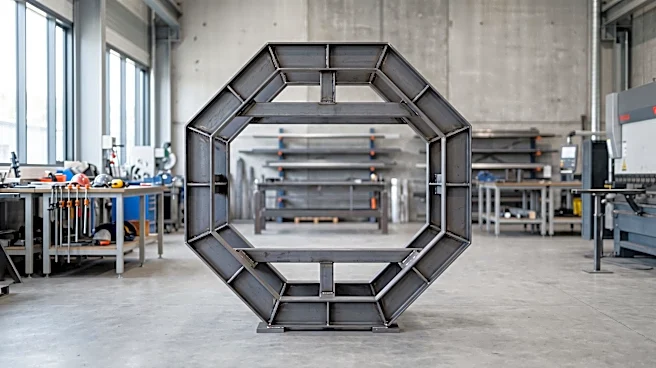
begins by requesting the circle's radius, including its value and units. Default parameters are then applied, specifying an 8-sided polygon (octagon), centered at the origin (0,0), with output units in feet. A key aspect of this methodology is the rotation of the polygon to ensure its top and bottom edges are horizontal, rather than having vertices at these positions. This is achieved by setting a starting angle equal to half of the central angle, which for an 8-sided polygon is 22.5 degrees. This orientation is preferred in structural engineering as it provides flat faces, simplifying the layout and detailing of reinforcement. Each vertex's coordinates (x, y) are computed using standard trigonometric formulas: x = r * cos(θ) and y = r * sin(θ), where 'r' is the radius and 'θ' is the vertex angle. The output format includes a summary of parameters, a table of vertex coordinates, and an Excel-ready block of X and Y values, rounded to a default of three decimal places.
Why It's Important?
This precise method for generating polygon coordinates holds significant importance for U.S. structural engineering and construction industries. By ensuring horizontal edges, the approach directly addresses practical challenges in reinforcement layout and detailing, which can lead to more efficient and robust structural designs. This standardization reduces complexity in the design phase, potentially accelerating project timelines and lowering costs associated with intricate reinforcement work. For engineers, having a clear, reproducible method for generating these coordinates minimizes errors and enhances the accuracy of their designs, particularly in projects involving circular piers or similar structures where polygonal shapes are integrated. The Excel-ready output further streamlines the workflow, allowing for direct integration into design software and analysis tools, thereby improving productivity and data consistency across different stages of a project. This systematic approach contributes to higher safety standards and structural integrity in U.S. infrastructure development.
What's Next?
The outlined methodology is expected to be adopted by structural engineers and design firms working on projects requiring precise polygonal geometries. Future developments may include integrating this coordinate generation process directly into CAD software or specialized structural analysis programs, further automating the design workflow. There could also be an expansion of this methodology to accommodate polygons with varying numbers of vertices and different rotational requirements, catering to a broader range of structural applications. Training and educational materials for engineers on this specific approach might also be developed to ensure widespread understanding and implementation. The focus will likely remain on refining the process to enhance efficiency, reduce potential for human error, and ensure compliance with evolving engineering standards and best practices in the U.S. construction sector.
Beyond the Headlines
The underlying principles of this coordinate generation method extend beyond immediate structural applications, touching upon broader implications in computational design and digital fabrication within the U.S. engineering landscape. The emphasis on precise, reproducible geometric data highlights a growing trend towards algorithmic design in architecture and engineering, where complex shapes can be accurately defined and manufactured. This approach could influence the development of new construction techniques, such as modular prefabrication, where components with exact polygonal forms are produced off-site and assembled on-site. Furthermore, the focus on simplifying reinforcement layout through specific polygon orientations suggests a deeper consideration of constructability during the design phase, fostering a more integrated design-to-construction pipeline. This shift towards data-driven, geometrically precise design methodologies could ultimately lead to more innovative and sustainable building practices across the U.S., impacting material usage, waste reduction, and overall project efficiency.