



What's Happening?
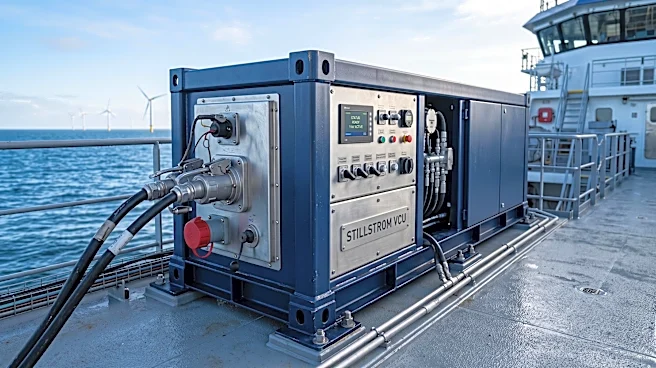
Stillstrom by Maersk has successfully completed the construction and factory acceptance testing of what it claims to be the world's first 11kV connection system designed for charging service operation vessels (SOVs) directly from offshore wind farms.
This achievement, witnessed by DNV, signifies a transition from theoretical design to functional hardware in offshore vessel charging. The core of this innovation is Stillstrom's proprietary Vessel Container Unit (VCU), a modular, vessel-mounted interface for charging and control. This unit is engineered for installation on both newbuild and retrofitted vessels, housing an 11kV connector package that supports various connection points on a vessel, including bow, stern, or under-deck. The modularity of the VCU also allows for its transfer between vessels, provided the onboard cabling is compatible. An integrated funnel within the unit facilitates optimal vessel heading during charging and grants the dynamic positioning operator control over charging and disconnection processes.
Why It's Important?
This development is crucial for the decarbonization efforts within the maritime industry, particularly for vessels supporting the rapidly expanding offshore wind sector. By enabling SOVs to charge directly from offshore wind farms, the system significantly reduces reliance on fossil fuels, thereby lowering operational emissions and fuel costs. This innovation addresses a critical gap in sustainable offshore operations, offering a practical solution for powering support vessels with renewable energy. The ability to transfer the VCU between vessels enhances its utility and economic viability, promoting wider adoption. The successful testing and DNV witnessing provide a strong validation of the technology, paving the way for its integration into offshore wind logistics and contributing to a greener energy ecosystem. This could set a new standard for offshore vessel operations and accelerate the transition to more sustainable practices in the U.S. offshore wind industry.
What's Next?
Stillstrom anticipates that its complete charging system will be ready for extensive offshore trials by the summer of 2027. Concurrently, work is progressing on the wind farm topsides interface, which is a critical component for the system's full functionality. Lessons learned from the prototype are already being incorporated into the design of a Mark 2 version, which aims to advance the current semi-automatic alignment system towards full automation. Graeme Wood, Stillstrom UK managing director, emphasized that the VCU's successful construction and testing mean that 'charging at sea is no longer a concept' for vessel operators. The company will continue to refine the technology, focusing on enhancing automation and ensuring robust performance in challenging offshore environments, with further developments expected to influence future offshore wind infrastructure and vessel design.
Beyond the Headlines
The introduction of an 11kV vessel connector for offshore wind charging represents a significant step towards energy independence for offshore operations. Beyond the immediate environmental and economic benefits, this technology could foster a new paradigm for maritime logistics, where vessels become integral components of the renewable energy grid rather than solely consumers of fossil fuels. The development highlights the increasing convergence of energy production and consumption in specialized industrial sectors. It also underscores the growing importance of robust, marinized electrical infrastructure capable of withstanding harsh offshore conditions. This innovation could spur further research and development in high-voltage offshore power transfer, potentially leading to broader applications in other marine industries and contributing to the long-term sustainability of global shipping and offshore activities.