


What's Happening?
In 2027, the European Union is set to finalize two major industrial policy initiatives: the automotive package and the Industrial Accelerator Act (IAA). These initiatives aim to address economic security and decarbonization. A key debate within the EU
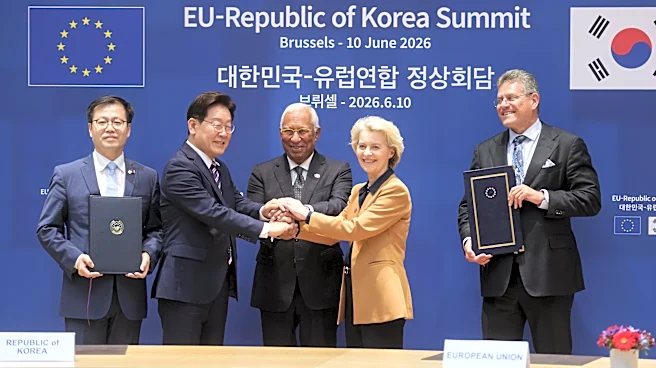
is whether to implement 'Made in EU' requirements for public procurement and support, or to adopt a more open 'Made with Europe' approach that includes free-trade partners. The 'Made in EU' approach, if strictly applied, could undermine existing trade commitments with countries like Japan and South Korea, potentially disrupting investments and trust. Alternative proposals suggest including 'trusted partners' based on three criteria: commitment to the Paris Agreement on climate change, reciprocity in procurement and public incentives, and readiness to cooperate on economic security. This 'coalition of the willing' approach would allow FTA partners meeting these criteria to have EU-equivalent access to procurement and public incentives, fostering diversified supply chains and reducing dependencies.
Why It's Important?
This policy shift is crucial for the EU's economic future, as it seeks to balance domestic industrial growth with global trade relationships and climate goals. A 'Made with Europe' approach could strengthen alliances with key partners, such as the U.S., Japan, and South Korea, by ensuring fair access to EU markets and incentives. This is particularly important for developing alternative supply chains for critical materials and technologies, reducing reliance on dominant suppliers like China. The emphasis on the Paris Agreement and decarbonization also aligns with global efforts to combat climate change, potentially driving innovation in green technologies. For U.S. businesses, this could mean continued or enhanced access to the EU market, especially if the U.S. aligns with the EU's criteria for 'trusted partners.' Conversely, a protectionist 'Made in EU' stance could lead to trade disputes and hinder transatlantic cooperation on economic security and climate initiatives.
What's Next?
The European Parliament and the Council of the EU are currently working to establish their institutional positions on the automotive package and the IAA. The outcome of these discussions will determine the final scope of the 'Made in EU' versus 'Made with Europe' approach. The EU will likely continue to engage with its free-trade partners to ensure that any new policies are mutually beneficial and do not inadvertently create new trade barriers. The development of a 'coalition of the willing' based on shared commitments to decarbonization and economic security will be a key focus. This could lead to new forms of cooperation on investment projects and the development of diversified green value chains. The U.S. will be closely watching these developments, as they could influence future trade relations and opportunities for American companies.
Beyond the Headlines
The EU's internal debate reflects a broader global challenge: how to protect domestic industries and ensure economic security while maintaining open and fair international trade. The 'loyalty tests' previously imposed by the U.S., such as pushing partners to align with U.S. export controls, highlight the complexities of defining 'economic security' in a multipolar world. The EU's emphasis on shared objectives like supply chain diversification, rather than alignment with specific national policies, suggests a more collaborative model for international economic security. This approach could set a precedent for how major economic blocs navigate the delicate balance between national interests and global cooperation in an increasingly interconnected and volatile world.