





What's Happening?
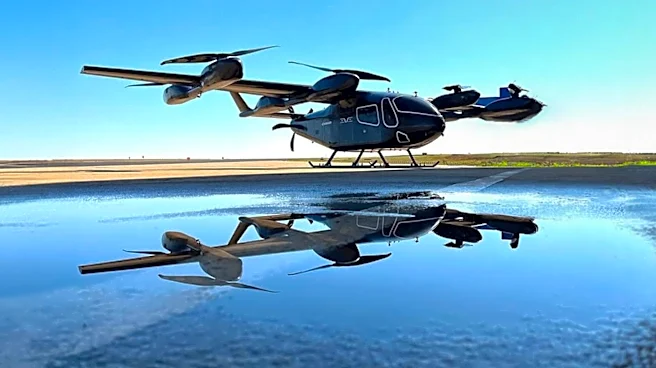
Sikorsky, a subsidiary of Lockheed Martin, has successfully conducted the first flight of its Nomad 100 rotor-blown wing prototype. This event, announced at the Farnborough International Airshow, marks a significant milestone in VTOL (Vertical Take-Off
and Landing) aircraft design. The Nomad 100 is part of the DARPA's Early VTOL Aircraft Demonstration (EVADE) program and aims to combine the advantages of fixed-wing and rotorcraft designs. The aircraft uses a blown-wing principle, allowing it to operate from constrained spaces without the need for runways. The initial flight test validated the rotor-blown wing configuration and demonstrated the autonomous MATRIX onboard system's ability to manage flight dynamics.
Why It's Important?
The successful flight of the Nomad 100 represents a major advancement in VTOL technology, offering potential applications in military operations such as reconnaissance, maritime patrol, and resupply. The ability to operate from unprepared areas without specialized support equipment enhances operational flexibility and efficiency. This development could lead to a new class of autonomous drones capable of performing a wide range of missions, potentially transforming military logistics and strategy. The Nomad 100's design also addresses some of the traditional limitations of VTOL aircraft, such as speed and payload capacity, by integrating fixed-wing benefits.
What's Next?
Sikorsky will continue testing the Nomad 100 to further validate its capabilities and refine its design. The company plans to develop a scalable family of Nomad drones, potentially expanding their use in various military applications. As the technology matures, it may attract interest from military and defense agencies looking to enhance their operational capabilities. The success of the Nomad 100 could also spur further innovation in VTOL technology, leading to new designs and applications beyond the military sector.