


What's Happening?
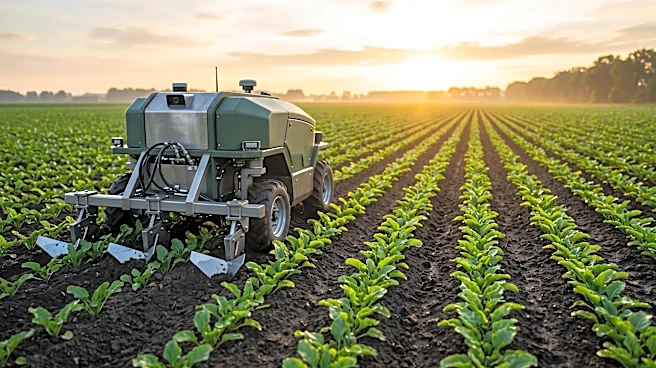
Engineers at North Dakota State University (NDSU) have developed and field-tested an autonomous mechanical weeding robot that demonstrated 96.5% efficacy in removing weeds from row-crop fields. This system significantly reduces unnecessary soil disturbance
by nearly half. The robot, detailed in a paper published in the journal Precision Agriculture, addresses the challenges of herbicide resistance and rising labor costs by providing a non-chemical weeding option. It combines a commercial mobile platform with a custom-built three-row cultivator. Each cultivator unit features an electric linear actuator for independent depth adjustment and uses RTK-GPS for centimeter-level positioning accuracy. Strain gauge load cells and laser distance sensors provide real-time feedback, allowing the control system to adjust the sweep blades as needed. In trials, the robot maintained tillage depth within 2 millimeters of the 30-millimeter target and achieved 50% weed coverage while reducing overall soil disturbance by 48.7% compared to less targeted methods.
Why It's Important?
This development is significant for U.S. agriculture, particularly for sugar beet and similar row crops, as it offers a viable alternative to chemical weed control. The increasing prevalence of herbicide-resistant weeds poses a substantial threat to crop yields and necessitates new solutions. By providing a precise mechanical weeding method, the NDSU robot can help farmers reduce their reliance on herbicides, potentially lowering input costs and mitigating environmental impacts. The reduction in soil disturbance is also crucial for soil health, preventing erosion and maintaining soil structure, which are long-term benefits for agricultural sustainability. Furthermore, in an era of rising labor costs and shortages, autonomous solutions like this robot can enhance efficiency and productivity, ensuring the economic viability of farming operations. This technology could lead to a paradigm shift in how weed management is approached, moving towards more sustainable and precise practices.
What's Next?
While the current prototype operates at a slower pace (0.5 meters per second) compared to traditional tractor-mounted cultivators or herbicide sprayers, the researchers view it as a proof of concept for the sensing and control architecture. The next steps involve developing faster actuators, implementing higher-frequency positioning updates, and potentially deploying multiple units in parallel to achieve commercial-scale viability for large-scale row-crop production. The NDSU team anticipates that further advancements will enable the robot to operate at speeds comparable to conventional methods, making it a practical solution for a wider range of agricultural applications. Continued research and development will focus on optimizing the system's speed and scalability, with potential for commercialization and widespread adoption in the coming years.
Beyond the Headlines
The NDSU robot's success in precise mechanical weeding highlights a broader trend in agricultural technology: the integration of artificial intelligence and robotics to address complex farming challenges. This approach moves beyond simple automation to intelligent systems that can adapt and respond to real-time field conditions. The ability to precisely target weeds without damaging crops or excessively disturbing the soil represents a significant leap forward, offering a blueprint for future agricultural machinery. This technology could also influence policy discussions around sustainable farming practices, potentially leading to incentives for adopting non-chemical weed control methods. The ethical implications of increased automation in agriculture, including potential impacts on agricultural labor, will also be a growing consideration as these technologies become more prevalent.