





What's Happening?
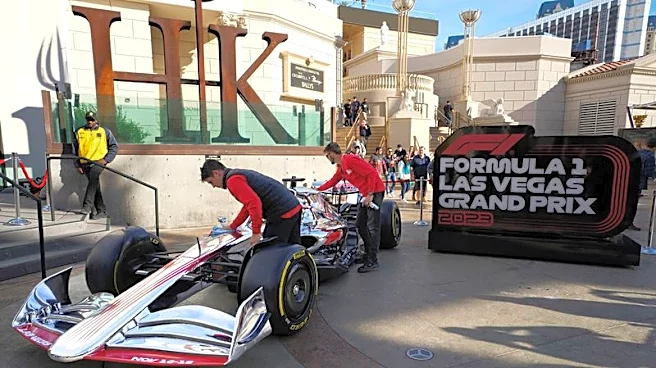
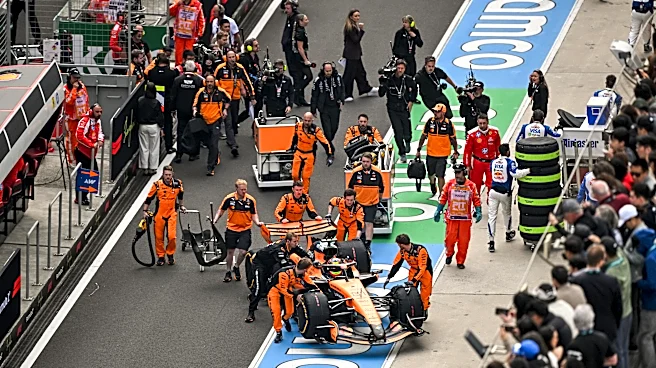
McLaren driver Oscar Piastri will incur a 10-place grid penalty at the upcoming Las Vegas Grand Prix. This penalty stems from Piastri exceeding his season's engine allowance, requiring a fifth internal combustion engine to complete the 2026 Formula 1 season.
This marks the first time in his F1 career that the Australian driver has surpassed the engine limit. McLaren confirmed the penalty, attributing the need for a new engine to reliability issues. Despite the setback, the team expressed optimism about Piastri's ability to recover positions during Saturday's race through overtaking. Additionally, McLaren plans to equip its cars with Mercedes' upgraded turbocharger, anticipating a minor performance enhancement. Piastri has experienced a challenging season, with a notable performance gap emerging between him and his teammate, Lando Norris, who holds a 94-point lead in the overall world drivers’ championship.
Why It's Important?
This grid penalty significantly impacts Oscar Piastri's performance prospects at the Las Vegas Grand Prix, forcing him to start further down the grid and making it more challenging to score points. For McLaren, while they anticipate a small performance boost from the new turbocharger, the engine reliability issues leading to this penalty highlight potential underlying technical challenges within the team's power unit management. The disparity in performance between Piastri and Norris, as noted by McLaren CEO Zak Brown, suggests a complex interplay of driver adaptation to new car regulations and Norris's exceptional current form. This situation could affect McLaren's overall constructor championship standing if Piastri consistently struggles to secure strong finishes. For fans and competitors, it adds an element of strategic intrigue to the Las Vegas race, as Piastri will need to execute a strong recovery drive.
What's Next?
Oscar Piastri will start the Las Vegas Grand Prix at least 10 positions lower than his qualifying result, necessitating a strategic approach to the race. His immediate focus will be on maximizing his performance during qualifying to minimize the impact of the penalty and then executing an effective race strategy to gain positions. McLaren will be closely monitoring the performance of the new Mercedes upgraded turbocharger to assess its impact and gather data for future developments. The team will also continue to analyze the reasons behind Piastri's struggles with the new car regulations and work on adaptations to his driving style. The performance gap between Piastri and Norris will likely remain a point of discussion, with Piastri aiming to close that gap in the remaining races of the season and during the off-season.
Beyond the Headlines
The situation with Oscar Piastri's engine penalty and performance disparity highlights the intricate balance between technological innovation, regulatory compliance, and driver adaptation in Formula 1. The engine allowance rules are designed to control costs and promote reliability, but exceeding them, even due to reliability issues, carries significant sporting consequences. Piastri's challenge in adapting to the new car regulations, as noted by Zak Brown, underscores how subtle changes in vehicle dynamics can profoundly affect even elite drivers. This scenario also brings into focus the psychological aspect of racing, where a driver's confidence and ability to 'click' with a car are crucial. The team's decision to introduce an upgraded turbocharger, even for a 'relatively small' boost, reflects the relentless pursuit of marginal gains in F1, where every fraction of a second can make a difference.