




What's Happening?
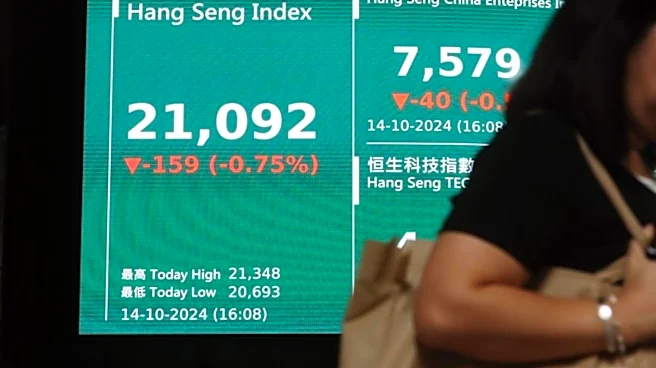
The Hang Seng Tech Index has experienced a continuous decline for the sixth straight session, falling 1.47% to 3,703 points with a turnover of HK$23.4 billion (approximately $3.0 billion). This drop has pushed the index below its late-October low. The primary
catalysts for this negative sentiment are the recent earnings misses from major Chinese tech companies, Baidu Inc. and JD.com Inc. Baidu's shares plunged 6.8% following its results, making it the worst-performing blue chip, while JD.com fell 2.59%. Other tech giants like Alibaba Group Holding and Tencent Holdings also saw significant drops of 4.94% and 3.02%, respectively. Industry analysts attribute this downturn to the dual pressures of the earnings season and substantial investments in artificial intelligence (AI) by these companies. Everbright Securities International strategist Kenny Ng Lai-yin noted that companies with a high proportion of traditional business revenue are facing intense market competition, leading to disappointing results. Blue Water Capital chief investment officer Li Zeming highlighted that AI investments are causing free cash flow to turn into net outflows for many tech giants, a concern previously seen with U.S. tech companies like Amazon and Alphabet.
Why It's Important?
The sustained decline of the Hang Seng Tech Index signals growing investor apprehension regarding the profitability and financial health of major Chinese technology firms. This trend could have broader implications for global technology markets, particularly as U.S.-China tech tensions continue to influence investor sentiment. The focus on free cash flow erosion due to AI spending indicates a shift in how investors evaluate tech companies, prioritizing sustainable financial models over rapid growth at any cost. This could lead to a re-evaluation of investment strategies in the tech sector, potentially favoring companies with stronger cash flow generation or more mature AI monetization strategies. The market's reaction also reflects concerns about potential capital-raising activities by these companies at depressed share prices, which could further dilute shareholder value. The situation underscores the interconnectedness of global financial markets, as U.S. interest rate hike expectations and their impact on capital outflows from emerging markets like Hong Kong also play a significant role in market volatility.
What's Next?
Investors are now closely watching the upcoming earnings reports from other major tech players, including Tencent Holdings, Alibaba, Meituan, and Kuaishou Technology. The market's primary focus will be on the extent to which AI capital expenditures are impacting free cash flow and whether these companies will resort to equity financing at current low share prices. If the pressure on free cash flow is confirmed across the sector post-earnings season, the valuation recovery for the Hang Seng Tech Index may depend more on concrete policy support rather than solely on the AI narrative. Additionally, external factors such as the path of U.S. interest rate hikes and renewed outflows of overseas capital will continue to influence market sentiment. CICC strategist Liu Gang suggests that investors should remain patient, as the bottoming out of Hong Kong stocks may require more substantial policy intervention. The rotation of capital from large internet platforms towards policy beneficiaries like semiconductor companies, driven by expectations of Chinese-made substitution due to U.S. chip export restrictions, is also a trend to monitor.
Beyond the Headlines
The current market dynamics in Hong Kong's tech sector highlight a deeper structural shift within the global technology landscape. The intense competition and the high capital expenditure required for AI development are forcing a re-evaluation of business models and financial sustainability for tech giants. This could lead to a consolidation within the industry, where companies with stronger balance sheets and more efficient AI integration strategies emerge as leaders. Furthermore, the interplay between U.S. monetary policy, U.S.-China geopolitical tensions, and the performance of Asian tech markets underscores the complex web of factors influencing global investment decisions. The emphasis on domestic chipmakers in mainland China, driven by U.S. export restrictions, points to a potential long-term decoupling or at least a significant reorientation of global supply chains in critical technology sectors. This could foster greater self-reliance in certain regions but also create new challenges for international collaboration and innovation.