





What's Happening?
QuEra Computing, a company with roots in Harvard and MIT research, asserts that useful quantum computers will be available within two years. This claim, articulated by Chief Commercial Officer Yuval Boger, suggests a rapid transition from current quantum systems,
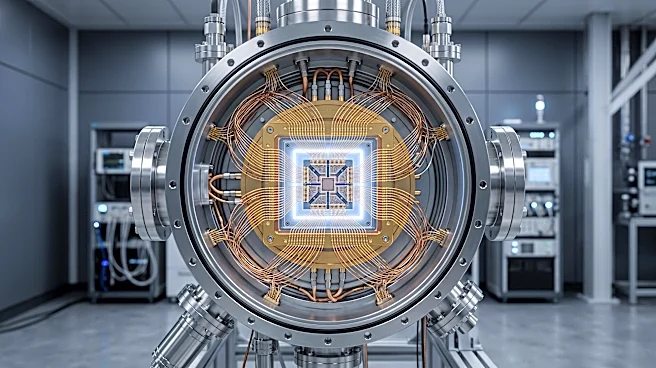
which he describes as 'toys,' to tools capable of solving complex problems beyond classical computing capabilities. The company's prediction is based on a publicly available roadmap, supported by eight peer-reviewed papers detailing the foundational elements of its Libra fault-tolerant system. QuEra plans to deliver its Libra system, designed for 256 error-corrected logical qubits from over 10,000 physical qubits, on Amazon Braket in 2028. This system aims for a logical error rate of 10⁻⁶. The company also projects a Gigaquop-class system for 2028-2029, targeting over 1,000 logical qubits from approximately 20,000 physical qubits with an even lower error rate of 10⁻⁹. QuEra's neutral atom architecture allows for all-to-all qubit connectivity, physically moving atoms to establish interactions, which eliminates the need for SWAP gates and reduces latency. This approach, combined with high-rate error-correcting codes, is reducing the ratio of physical to logical qubits required for fault tolerance. The platform operates at room temperature, avoiding the complexities and costs associated with cryogenic systems.
Why It's Important?
QuEra Computing's aggressive timeline for useful quantum computers could significantly impact the U.S. technology and research sectors. If successful, this development would accelerate the practical application of quantum computing in fields like chemistry and materials science, where quantum mechanics governs underlying behaviors. The ability to simulate complex molecular interactions with high precision could revolutionize drug discovery, advanced materials development, and energy research. The partnership with Hewlett Packard Enterprise (HPE) to integrate QuEra’s systems with the HPE Cray supercomputing platform signifies a move towards making quantum resources accessible on-premise, potentially democratizing access to advanced computing capabilities for various industries. This could give U.S. companies a competitive edge in innovation by enabling them to tackle problems currently intractable for classical supercomputers. Furthermore, the emphasis on co-design partnerships and building a quantum ecosystem suggests a proactive approach to ensure that industries are prepared to utilize quantum technology upon its arrival, fostering a new wave of technological advancement and economic growth. However, the ambitious timeline also places pressure on the quantum computing community to deliver on these promises, as the field has historically faced skepticism due to unfulfilled predictions.
What's Next?
QuEra Computing's immediate next steps involve the continued development and delivery of its Libra fault-tolerant system on Amazon Braket in 2028. This will be a critical milestone in validating the company's claims regarding the reduction of the quantum error correction tax and the feasibility of achieving practical quantum computation within its projected timeline. The company will also continue to expand its co-design partnerships through initiatives like the FTQC Founder’s Circle, focusing on identifying concrete quantum-relevant problems and building classical benchmarks. This collaborative approach aims to ensure that when the Libra system becomes available, there are established use cases and a prepared ecosystem to leverage its capabilities effectively. Further research and development will focus on scaling to the Gigaquop-class system, aiming for over 1,000 logical qubits by 2028-2029. The integration with HPE Cray supercomputing platforms will also progress, providing on-premise access to quantum resources and expanding the reach of QuEra's technology. The quantum computing community will closely monitor QuEra's progress, particularly regarding the validation of its peer-reviewed research and the performance of its upcoming systems.
Beyond the Headlines
The bold claims by QuEra Computing extend beyond mere technological advancement, touching upon the broader ethical and economic implications of quantum supremacy. If quantum computers indeed become 'useful' within two years, it could trigger a significant shift in global technological leadership, with the U.S. potentially solidifying its position at the forefront of this revolution. The ability to solve problems currently beyond classical computers raises questions about data security, cryptography, and national defense, as existing encryption methods could become vulnerable. The emphasis on 'co-design partnerships' highlights a strategic move to integrate quantum capabilities into existing industrial workflows, suggesting a future where quantum computing is not a standalone technology but an accelerator within hybrid computing environments. This integration could lead to a re-evaluation of workforce skills, necessitating new educational programs and training to prepare for a quantum-enabled economy. The debate sparked among quantum professionals by QuEra's specific timeline underscores the ongoing tension between ambitious projections and the complex realities of quantum physics, emphasizing the need for rigorous validation and transparent progress in a field often characterized by hype. The shift from 'toys' to 'tools' also implies a maturation of the quantum industry, moving from theoretical exploration to practical application, which could attract substantial investment and foster intense competition.