








What's Happening?
AGIBOT Innovation Technology Co. has announced the production of its 15,000th robot, marking a significant milestone in the deployment of embodied AI systems. The company, founded in 2023, has rapidly scaled its production capabilities, moving from 1,000
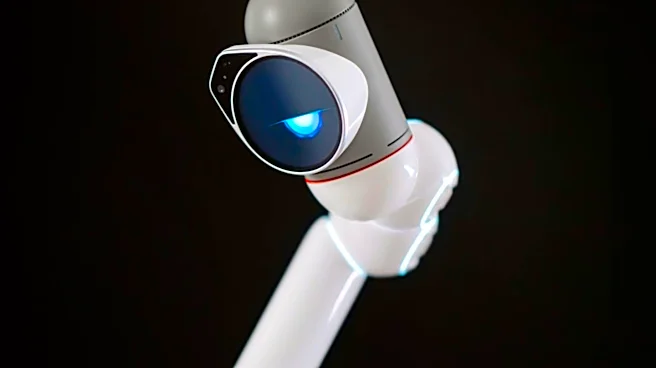
to 5,000 units in a year and then accelerating to 15,000 units. The milestone robot, an AGIBOT G2, is a wheeled mobile manipulator designed for industrial tasks. This achievement reflects AGIBOT's progress in transitioning from product validation to large-scale deployment, showcasing its capabilities in product development, supply chain readiness, and standardized manufacturing. The company emphasizes the importance of integrating robot body design, software-hardware integration, and application-specific adaptation to bring embodied AI into real-world use.
Why It's Important?
The production of the 15,000th robot by AGIBOT highlights the growing trend of scaling AI systems for real-world applications. This development is significant for the robotics industry as it moves beyond proof-of-concept projects to large-scale production and deployment. AGIBOT's success in this area positions it as a leader in the global market for humanoid robots, with a reported 39% market share in 2025. The ability to sustain large-scale production and deployment is becoming a crucial measure of industrialization capability in the robotics sector. This milestone not only demonstrates AGIBOT's engineering and manufacturing prowess but also indicates a broader industry shift towards the industrialization of AI technologies.
What's Next?
AGIBOT plans to continue advancing the industrialization of embodied AI through scaled delivery and deployment. As the industry moves towards real-world applications, AGIBOT aims to bring robots into more scenarios, enhancing their utility in industrial, commercial, and public-service environments. The company is also engaging in initiatives like the World Challenge alongside ICRA to demonstrate the capabilities of AI models in enabling robotics for industrial tasks. As more robots enter various environments, the focus will be on sustaining production and ensuring reliable delivery and deployment, which will be key to maintaining leadership in the market.
Beyond the Headlines
The milestone achieved by AGIBOT reflects deeper implications for the robotics industry, particularly in terms of ethical and operational challenges. As robots become more integrated into industrial and public-service environments, issues such as job displacement, ethical use of AI, and the need for regulatory frameworks will become increasingly important. The ability to deploy robots at scale also raises questions about the long-term impact on labor markets and the potential need for reskilling workers. Additionally, the integration of AI in robotics necessitates ongoing discussions about data privacy, security, and the ethical use of AI technologies.