



What's Happening?
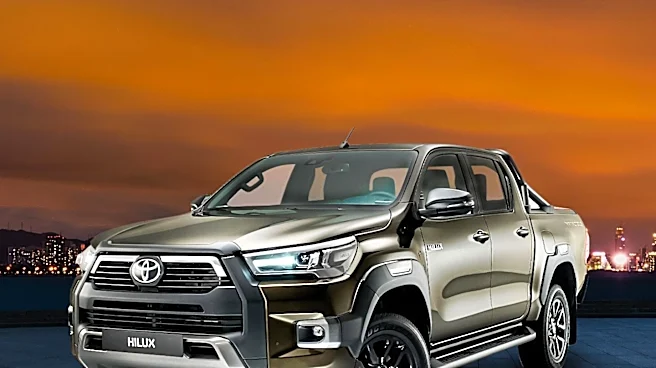
Toyota's Hilux Champ, a small truck primarily sold in Asian markets, is not available for purchase in the United States despite its low price point of approximately $12,500. The truck is offered with a 2.4L turbodiesel or 2.0L/2.7L gasoline engine, and
both five-speed manual and six-speed automatic transmissions. It boasts up to 150 horsepower, 295 lb-ft of torque, a towing capacity of over 5,500 pounds, and a one-ton payload. The long-wheelbase version features an 8.7-foot bed. While a 25% 'chicken tax' on imported pickup trucks and vans would add about $3,000 to the price, making it around $15,500, the primary barrier to its U.S. entry is its failure to meet stringent U.S. safety and emissions standards. The Hilux Champ lacks essential safety features such as ABS, traction control, airbags, and tire pressure monitors, and would require a backup camera, which has been mandatory in U.S. vehicles since 2018.
Why It's Important?
The unavailability of the Toyota Hilux Champ in the U.S. highlights the significant regulatory hurdles and costs associated with introducing vehicles into the American market. U.S. safety standards, enforced by the NHTSA, are among the highest globally, requiring features like crumple zones, rigid cabs, and specific safety equipment that the Hilux Champ currently lacks. Additionally, none of the truck's current engine options meet EPA emissions standards, necessitating either adaptation or the development of new powertrains for the U.S. market. These requirements mean that a vehicle designed for other markets, even if affordable, would require a substantial redesign, crash testing, and re-engineering to comply with U.S. regulations. This situation underscores the challenges faced by automakers, including domestic companies like Ford and Slate, in developing truly inexpensive trucks for the U.S. market while adhering to modern safety and environmental mandates.
What's Next?
For the Toyota Hilux Champ to be sold in the U.S., Toyota would need to undertake a comprehensive redesign to incorporate mandatory safety features like ABS, traction control, airbags, and a backup camera. This would also involve significant structural modifications to meet crash test requirements, including the addition of crumple zones and a more rigid cab. Furthermore, the existing powertrains would need to be adapted or replaced to comply with EPA emissions standards. These extensive modifications, testing, and re-engineering efforts would substantially increase the truck's cost, likely pushing its price point closer to that of existing U.S. market trucks like the Ford Maverick or the Toyota Tacoma, which starts at over $32,000. Therefore, it is unlikely that the Hilux Champ, in its current form, will ever be introduced to the U.S. market as a low-cost option.
Beyond the Headlines
The case of the Toyota Hilux Champ illustrates a broader tension between global automotive manufacturing strategies and national regulatory frameworks. While consumers in some markets benefit from highly affordable, utilitarian vehicles, the U.S. market prioritizes advanced safety and environmental performance, often at a higher cost. This divergence reflects differing societal values and regulatory philosophies regarding consumer protection and environmental impact. The stringent U.S. standards, while increasing vehicle prices, are intended to reduce fatalities and injuries from accidents and mitigate environmental pollution. This dynamic also influences global trade and competition, as manufacturers must either design region-specific models or invest heavily in adapting existing ones, impacting product availability and pricing across different countries. The absence of the Hilux Champ in the U.S. is a tangible example of how these regulatory landscapes shape the automotive choices available to consumers.