








What's Happening?
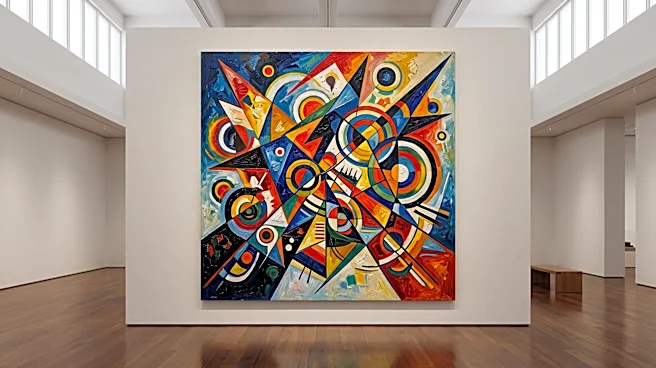
Wassily Kandinsky's abstract painting, 'Betonte Ecken' (Accentuated Corners), created between December 1922 and January 1923 during his early Bauhaus period, is scheduled for auction at Christie's New York on November 17, 2026. The oil on canvas, measuring
130 x 130 cm, carries a pre-sale estimate of $60 million to $80 million. The painting combines overlapping triangular planes, rings, arcs, sharp diagonals, fine lines, and contrasting colors, creating a dynamic composition. Its provenance includes ownership by Hilla Rebay, Solomon R. Guggenheim, and the Guggenheim Foundation, which sold it in 1964. More recently, Museum Barberini credited the work to the Nahmad Collection in 2025, and ARTnews reported in October 2026 that the Nahmad family is consigning the painting. This sale could potentially set a new auction record for Kandinsky, surpassing the previous record of approximately $44.8 million for 'Murnau mit Kirche II' in 2023.
Why It's Important?
The auction of 'Betonte Ecken' is significant for the U.S. art market and the broader cultural landscape. Its high estimated value reflects the enduring appeal and historical importance of Wassily Kandinsky, a pioneer of abstract art. The painting's journey through prominent American collections, including the Guggenheim, highlights its role in the early promotion and reception of European abstraction in the United States. A successful sale at or above the estimated price would not only establish a new benchmark for Kandinsky's work but also underscore the robust demand for high-value modern art. This event could influence future valuations of similar works and attract considerable attention from collectors, institutions, and art enthusiasts, further solidifying New York's position as a global art market hub. The sale also brings renewed focus to the Bauhaus movement and Kandinsky's pivotal contributions to geometric abstraction.
What's Next?
The primary immediate event is the auction at Christie's New York on November 17, 2026. The art world will closely watch the outcome to see if 'Betonte Ecken' reaches or exceeds its high estimate, potentially setting a new auction record for Kandinsky. Following the sale, the new owner, whether a private collector or an institution, will determine the painting's future public accessibility. The sale's result will likely be analyzed by art market experts to gauge trends in the modern art segment. Additionally, the extensive documentation and historical context surrounding 'Betonte Ecken' will continue to be a subject of art-historical study, particularly concerning Kandinsky's transition into geometric abstraction during his Bauhaus years and the painting's influence on the American art scene.
Beyond the Headlines
Beyond its monetary value, 'Betonte Ecken' offers profound insights into Kandinsky's artistic philosophy and the evolution of abstract art. The painting represents a crucial transitional moment in his career, where his earlier expressive abstraction merged with geometric ideas encountered in Russia and the Bauhaus's emphasis on elementary forms. The existence of a preparatory study from 1922, held by the Montreal Museum of Fine Arts, provides a rare glimpse into Kandinsky's creative process and his deliberate approach to composition. Furthermore, comparing 'Betonte Ecken' with 'Composition 8,' painted just months later, reveals Kandinsky's continuous exploration of how abstract shapes can create order without becoming static. The painting's provenance, particularly its connection to Hilla Rebay and Solomon R. Guggenheim, underscores its role in shaping the institutional promotion of abstract art in the U.S., highlighting the cultural and intellectual shifts that embraced non-objective art in the 20th century.