


What's Happening?
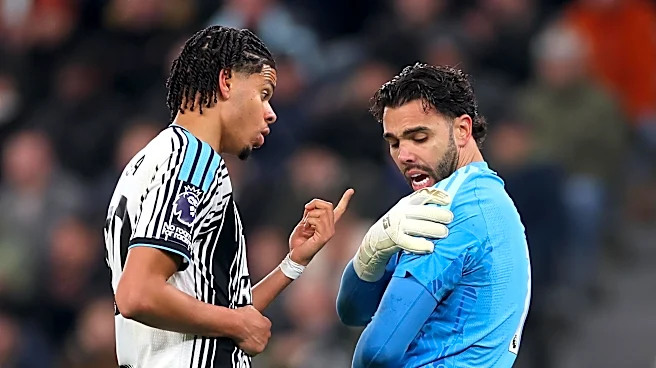
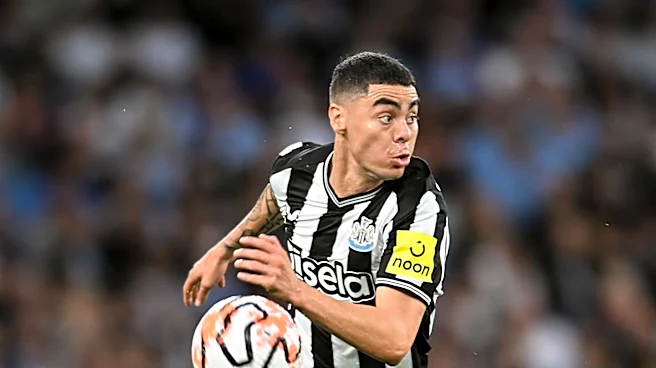
Newcastle United's summer transfer strategy has come under renewed scrutiny after head coach Matthias Jaissle excluded two significant signings, Aladji Bamba and Bazoumana Toure, from the squad for a recent match against Arsenal. Bamba, a £30 million
addition, has yet to start for Newcastle, while Toure, a £43 million winger, has not made his full Premier League debut. Club chairman Yasir Al-Rumayyan was present at St James' Park during the match, observing Jaissle's selection decisions. Jaissle explained that his choices were based on finding the right balance within the squad, emphasizing the importance of impact players. He acknowledged that the team's relatively inexperienced squad leads to inconsistency, as highlighted by their performance against Arsenal, where established players led a second-half comeback after summer arrivals Sean Steur and Amar Dedic were substituted at halftime.
Why It's Important?
This situation highlights the challenges faced by U.S.-owned sports franchises, such as Newcastle United, in balancing significant financial investments with on-field performance and team integration. The Public Investment Fund (PIF) of Saudi Arabia, which owns Newcastle United, has made substantial investments in the club, and the performance of these high-value transfers directly impacts the return on investment and the club's overall strategic goals. The exclusion of expensive new signings from the starting lineup, particularly in the presence of the chairman, underscores potential tensions between recruitment strategies and coaching decisions. For U.S. investors and sports business stakeholders, this scenario illustrates the complexities of managing international sports assets, where large capital outlays do not always guarantee immediate success or seamless player integration. It also brings into focus the pressure on coaches to deliver results while developing a young, expensive squad.
What's Next?
The coming weeks will be crucial for Bamba and Toure as they aim to regain their places in the squad, with Newcastle preparing for an upcoming match against Brighton & Hove Albion. Jaissle's comments suggest that their absence is not necessarily permanent, leaving the door open for their return. However, with the January transfer window approaching, the club will need to assess how to balance its long-term recruitment strategy, which has focused on younger players, with the immediate demands of the current season. The ongoing challenge for Jaissle is to translate encouraging spells into consistent performances and integrate the expensive, inexperienced summer recruits effectively. The decisions made in the near future regarding player selection and potential further transfer activity will be closely watched by fans and stakeholders, including the PIF, as they seek to optimize their investment in the club.
Beyond the Headlines
The situation at Newcastle United reflects a broader trend in global football where significant financial backing from sovereign wealth funds or wealthy owners often leads to high-value transfers. However, the integration of these players into a cohesive team and the immediate impact on performance are not always guaranteed. This raises questions about the efficacy of 'moneyball' type strategies in football, where data-driven recruitment of younger, high-potential players is favored over established stars. The ethical dimension of such investments, particularly from state-backed funds, often comes under scrutiny, with expectations of both sporting success and broader economic or reputational benefits. The challenge for clubs like Newcastle is to navigate these complex dynamics, ensuring that financial power translates into sustainable sporting achievement while managing the expectations of both the ownership and the fanbase.