





What's Happening?
Ford Motor Company is strategically utilizing its strong market position in trucks and commercial fleets to finance its significant shift towards electric vehicles (EVs). The company generates substantial revenue through its Ford Pro and Ford Blue segments,
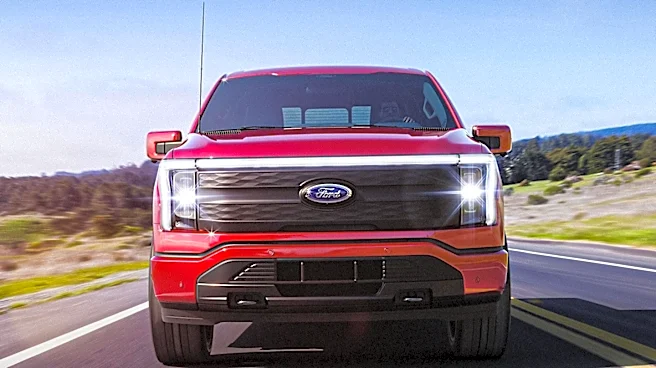
which focus on selling trucks, SUVs, and commercial vans to a diverse customer base including global retail, commercial, and government clients. This extensive operation is supported by a vast network of over 8,200 independently owned dealerships worldwide. Despite losing some market share over the past decade, now ranking third in U.S. car sales behind General Motors and Toyota with approximately 13% market share, Ford remains a major player, with the U.S. accounting for about 60% of its total sales. The company has evolved its product lineup to predominantly feature pickup trucks and SUVs, alongside its Mustang EV, and has set an ambitious goal to have hybrids and EVs constitute half of its sales volume by 2030.
Why It's Important?
Ford's strategy is crucial for its long-term competitiveness in the evolving automotive industry. By leveraging its profitable traditional segments, Ford aims to secure the necessary capital to invest in EV research, development, and manufacturing, which are capital-intensive endeavors. This approach allows Ford to maintain financial stability while navigating the transition away from internal combustion engines. The success of this strategy will determine Ford's ability to compete with established EV leaders and new entrants, impacting its market share, profitability, and overall standing in the global automotive landscape. Furthermore, Ford's commitment to increasing its hybrid and EV sales volume by 2030 signals a significant shift in the U.S. automotive market, potentially accelerating the adoption of electric vehicles and influencing consumer preferences and infrastructure development.
What's Next?
Ford is expected to continue its aggressive investment in electric vehicle technology and production capabilities. The company's goal of achieving 50% of its sales volume from hybrids and EVs by 2030 suggests a sustained focus on expanding its electric and hybrid offerings across its truck, SUV, and commercial van segments. This will likely involve further development of battery technology, charging infrastructure partnerships, and supply chain optimization to mitigate operational risks such as reliance on specific battery component suppliers. Ford will also need to address ongoing quality control issues and recalls, including those related to NHTSA consent orders, and manage legal challenges like class action litigation over fuel pump defects and investigations into its BlueCruise driver-assistance technology. The company's ability to effectively manage these challenges while executing its EV transition will be critical for its future success.
Beyond the Headlines
Ford's strategic pivot highlights a broader trend in the automotive industry where legacy automakers are adapting to meet environmental regulations and changing consumer demands for sustainable transportation. This transition is not merely about product development but also involves significant shifts in manufacturing processes, supply chain management, and workforce training. The company's reliance on its traditional truck and commercial fleet business to fund this transformation underscores the economic realities of such a massive undertaking. The success or failure of Ford's strategy could serve as a blueprint or cautionary tale for other established industries facing disruptive technological shifts. Moreover, the increased production of EVs by a major U.S. automaker like Ford has implications for national energy policy, job creation in the green economy, and the overall reduction of carbon emissions in the transportation sector.