




What's Happening?
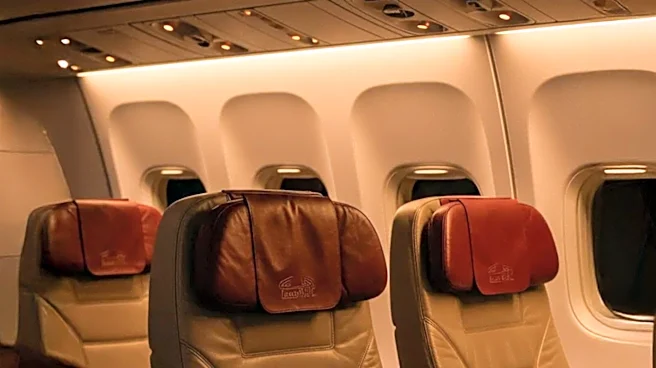
Singapore Airlines has revealed its new first and business class cabins, designed to offer passengers more space, increased privacy, and a more flexible environment. These upgraded cabins are slated for installation on the airline's Airbus A350-900 and Boeing
777-9 aircraft, with deployment expected to begin in the second half of 2027. The airline also plans to introduce new designs for its Premium Economy and Economy classes, aiming to provide greater comfort and space across all travel tiers. This initiative represents a significant investment by Singapore Airlines to enhance its customer travel experience, incorporating feedback from over 5,000 frequent flyers. The new first-class seats, designed by PriestmanGoode and manufactured by Collins Aerospace, will feature double beds in center configurations and high-end finishes. The business class, developed with Recaro and BMW’s DesignWorks, will introduce suite-style pods with closing doors for enhanced privacy. These developments are part of a multi-year investment exceeding 2 billion Singaporean dollars ($1.56 billion) in product improvements.
Why It's Important?
This significant investment by Singapore Airlines in its cabin products underscores a competitive drive within the global aviation industry to attract and retain high-value customers. For U.S. travelers, particularly those flying long-haul routes to Asia, these upgrades mean a more luxurious and comfortable travel experience, potentially influencing their choice of airline. The introduction of features like double beds in first class and private suites in business class sets a new benchmark for premium air travel, which could pressure other international carriers, including U.S.-based airlines, to innovate their own offerings to remain competitive. The focus on enhanced privacy, comfort, and technology reflects evolving passenger expectations, especially in the post-pandemic travel landscape where personal space and hygiene are increasingly valued. This move could also stimulate demand for premium travel segments, benefiting the broader travel and tourism industry by encouraging more long-distance international travel.
What's Next?
The new cabins will begin to be installed on Airbus A350-900 and Boeing 777-9 aircraft starting in the second half of 2027. Passengers can anticipate a phased rollout of these new cabin products across Singapore Airlines' long-haul fleet. The airline will also be updating its KrisWorld inflight entertainment systems on A350s and introducing new systems on the 777-9s, featuring 4K resolution and Bluetooth pairing. Additionally, Singapore Airlines plans to progressively roll out Starlink Wi-Fi service starting in 2027 on its Airbus A380s, A350-900 long-haul fleet, and A350-900ULRs. This will provide free Wi-Fi for business and first-class passengers, as well as KrisFlyer or PPS Club members across all cabins. Further announcements regarding specific routes and aircraft to receive the upgrades first are expected as the deployment date approaches, allowing travelers to plan their journeys to experience the new offerings.
Beyond the Headlines
Beyond the immediate comfort and luxury enhancements, Singapore Airlines' investment reflects a broader trend in the airline industry towards hyper-personalization and the creation of exclusive, private spaces within commercial aircraft. This shift could lead to a redefinition of what constitutes 'premium' travel, moving beyond just service to include architectural and technological innovations within the cabin itself. The emphasis on privacy, exemplified by closing doors in business class, could become a standard expectation, pushing airlines to rethink cabin layouts and passenger density. Furthermore, the integration of advanced technology like 4K entertainment systems and Starlink Wi-Fi highlights the increasing convergence of air travel with digital lifestyles, where seamless connectivity and high-quality digital experiences are paramount. This could also influence aircraft manufacturers to design future planes with greater flexibility for cabin customization and advanced technological integration, fostering a new era of in-flight experience design.