





What's Happening?
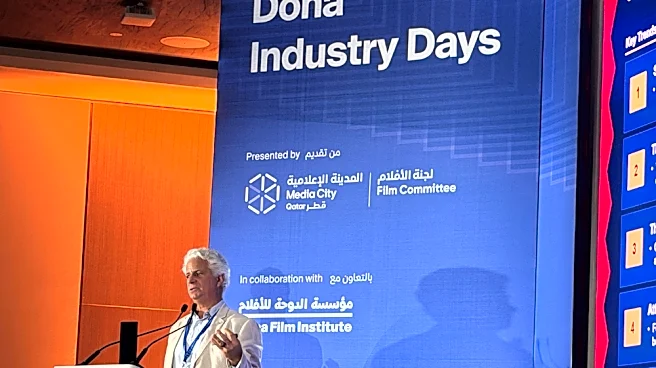
Todd Boehly, a billionaire investor whose holding company Eldridge has stakes in A24, recently discussed how co-founder Daniel Katz's financial expertise contributed to the studio's success. Speaking at the Qatar Film Committee’s Doha Industry Days, Boehly highlighted
Katz's ability to understand and manage risk, a skill he developed during his time on a trading floor at Guggenheim Partners from 2008 to 2012. Boehly noted that Katz's approach to film financing was rooted in structured finance, allowing him to identify profitable ventures and avoid costly failures, such as the $160 million disaster movie 'Poseidon'. Boehly provided $19 million in seed money for A24 when Katz launched the company in 2012 with David Fenkel and Joh Hodges. A24 was publicly valued at $3.5 billion in June 2024. Boehly emphasized that Katz's understanding of 'math' and risk distribution, rather than solely creative aspects, has been crucial to A24's strategic growth and profitability, enabling the company to build a recurring business model by fostering relationships with directors and actors.
Why It's Important?
This insight into A24's operational strategy underscores a significant shift in the entertainment industry, where financial acumen and risk management are increasingly vital for success. Boehly's comments suggest that traditional Hollywood, often perceived as creatively driven, may benefit from a more data-driven and financially structured approach. For U.S. industries, particularly in entertainment and finance, this highlights the value of cross-disciplinary expertise. Daniel Katz's background in structured finance, applied to film production and distribution, demonstrates how principles from one sector can revolutionize another. This model could influence how other creative industries seek investment and manage projects, potentially leading to more financially stable and sustainable ventures. It also indicates that investors are looking for more than just creative vision; they seek robust business models that can mitigate risk and ensure returns, impacting how new entertainment companies are funded and structured in the U.S.
What's Next?
The success of A24, attributed to its financially savvy approach, could inspire other independent film studios and entertainment companies to adopt similar strategies. This might lead to a greater emphasis on financial modeling, risk assessment, and structured financing in the U.S. entertainment sector. We may see more executives with backgrounds in finance and business taking leadership roles in creative industries, or a greater integration of financial experts into production and distribution teams. This trend could also influence film school curricula and industry training programs, incorporating more business and finance education for aspiring producers and studio executives. Furthermore, the continued growth and valuation of A24, driven by this strategic approach, could attract more institutional investors to the independent film market, seeking similar returns on investment through well-managed, risk-mitigated projects.
Beyond the Headlines
The narrative presented by Todd Boehly challenges the romanticized view of Hollywood as solely a creative endeavor, highlighting the often-overlooked financial engineering that underpins successful ventures. This perspective suggests a deeper cultural shift where artistic industries are increasingly subject to the rigorous analytical frameworks typically applied in finance. The ethical implication lies in balancing creative freedom with financial viability; while a structured approach can ensure sustainability, there's a risk of prioritizing profit over artistic innovation. Legally, this could lead to more complex financing structures and contractual agreements in film production, potentially altering the landscape for independent filmmakers seeking funding. Culturally, it might foster a new generation of 'producer-financiers' who are equally adept at understanding market trends and managing budgets as they are at recognizing creative talent, potentially reshaping the types of stories told and how they are brought to audiences.