


What's Happening?
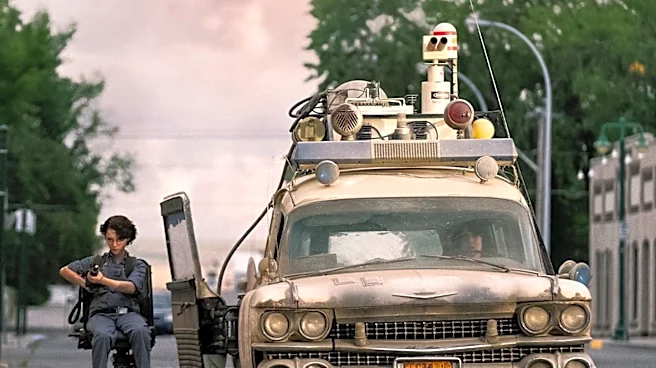
Annie Potts' character, Janine Melnitz, the secretary in the 1984 film 'Ghostbusters,' became iconic for her large, red-framed glasses. However, these distinctive glasses were not originally part of her costume design. According to Potts, the decision
to incorporate them was made spontaneously on set. During a costume fitting, director Ivan Reitman decided to include Potts in a scene unexpectedly. In a quick effort to visually transform into Janine, Potts borrowed a pair of large, 'Coke-bottle' glasses from the costume designer. This impromptu choice became a defining characteristic of the character and an enduring visual element of the film. The improvisation extended beyond just the glasses, as much of the film's dialogue and character interactions were also developed spontaneously by the comedic cast, including Bill Murray, Dan Aykroyd, and Harold Ramis.
Why It's Important?
The story behind Janine's glasses highlights the significant role of improvisation in the creation of 'Ghostbusters,' a film that became a cultural phenomenon. This spontaneous decision-making on set contributed to the movie's authentic comedic timing and character development, which resonated deeply with audiences. It underscores how creative flexibility and on-the-spot ingenuity can lead to iconic elements that were never initially planned. For the film industry, this serves as an example of how collaborative and adaptable environments can foster memorable cinematic moments. The enduring recognition of Janine's glasses, even decades later, demonstrates the lasting impact of such seemingly minor, yet pivotal, creative choices on a film's legacy and its characters' identities. This approach also showcases the talent of actors and crew to contribute beyond their scripted roles.
Beyond the Headlines
The improvised nature of Janine's glasses and much of 'Ghostbusters' reflects a broader creative philosophy prevalent in certain comedic productions, where spontaneity and actor input are highly valued. This approach can lead to more organic and authentic performances, as actors are given the freedom to shape their characters in real-time. However, it also presents challenges, requiring a director with a strong vision to guide and coalesce disparate improvisational elements into a cohesive narrative. The success of 'Ghostbusters' with this method suggests that a balance between structured writing and creative freedom can yield exceptional results. This case also illustrates how seemingly minor details, born out of necessity or spur-of-the-moment decisions, can become deeply ingrained in popular culture, influencing character design and audience perception for generations.