




What's Happening?
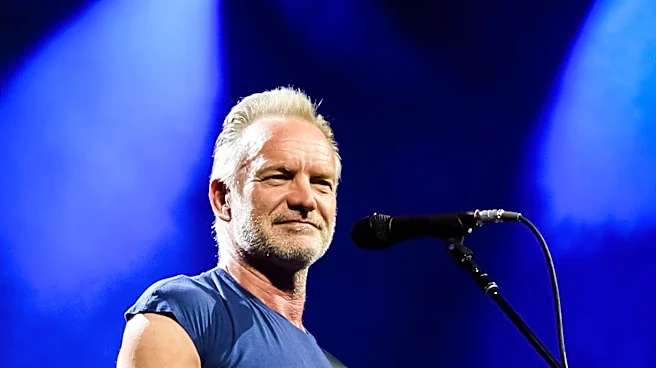
Sting, along with his company Magnetic Publishing Limited, is facing a legal dispute in London's High Court initiated by former Police bandmates Andy Summers and Stewart Copeland. The lawsuit centers on arrangement royalties for the hit song 'Every Breath
You Take,' specifically questioning how these agreements apply to streaming income. Summers and Copeland contend that their share should encompass digital plays, an interpretation that Sting's defense is contesting. The songwriting credit for 'Every Breath You Take' is solely registered to Sting. This legal action follows Sting's 2022 sale of his song catalog, including tracks from The Police, to Universal Music Group for an estimated $250 million. The song's creation during the 1983 'Synchronicity' album sessions was marked by significant tension, with Sting reportedly sustaining a broken rib from clashes with Copeland during the tour. Producer Hugh Padgham also recalled arguments over drum arrangements, highlighting the creative friction within the band.
Why It's Important?
This legal battle has significant implications for the music industry, particularly concerning intellectual property rights and royalty distribution in the digital age. The outcome could set a precedent for how arrangement royalties are calculated and distributed for streaming services, potentially affecting countless artists and their past works. For musicians like Summers and Copeland, a favorable ruling could unlock substantial new revenue streams from digital platforms, while for songwriters like Sting, it could redefine the financial landscape of their catalog sales. The case also underscores the ongoing complexities and potential disputes arising from the valuation and monetization of music catalogs, especially those with shared creative contributions but singular songwriting credits. The estimated $250 million sale of Sting's catalog highlights the immense financial stakes involved in such intellectual property.
What's Next?
The London High Court will continue to hear arguments regarding the interpretation of arrangement royalty agreements and their applicability to streaming income. The court's decision will determine whether Summers and Copeland are entitled to a share of digital play royalties for 'Every Breath You Take.' This ruling could lead to further legal challenges or renegotiations of existing royalty agreements across the music industry, particularly for legacy acts whose works are experiencing renewed popularity through streaming. The case may also influence future contracts for artists, potentially leading to more explicit clauses addressing digital revenue streams and the division of arrangement credits. The ongoing nature of the dispute, 42 years after the song's release, suggests a protracted legal process.
Beyond the Headlines
The dispute over 'Every Breath You Take' extends beyond mere financial considerations, touching upon the often-contentious nature of creative collaboration and credit within bands. Stewart Copeland's past comments, calling it Sting's 'best song with the worst arrangement,' and Andy Summers' claim that the song was 'about to end up in the bin' until his contribution, reveal deep-seated disagreements over the song's artistic genesis and the value of individual contributions. This case highlights the subjective and often emotional aspects of attributing creative ownership, especially when a single individual holds the primary songwriting credit. It also raises questions about the long-term impact of internal band dynamics on the legacy and financial future of their music, even decades after their active collaboration has ceased.