






What's Happening?
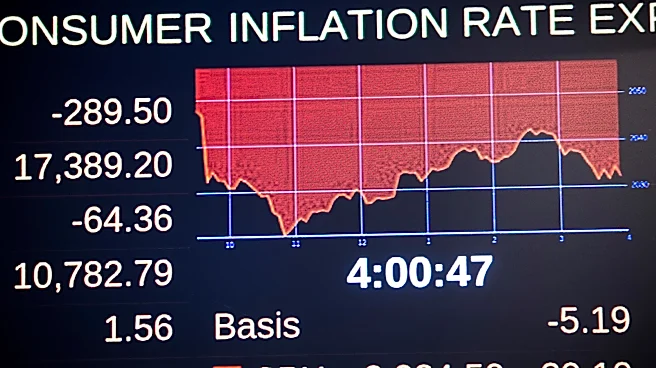
European Central Bank (ECB) Vice President Boris Vujcic and Governing Council member Martin Kocher have indicated that additional monetary tightening may be required as eurozone inflation remains at 4%, double the ECB's 2% target. In an interview with
Austrian newspaper Kurier, Vujcic stated that market expectations for a December interest rate increase are consistent with current economic conditions. Investors have fully priced in a 25-basis-point hike next month, with projections suggesting two to three more increases by the end of 2027. Kocher, who also leads Austria's central bank, warned that sustained high energy prices could lead to second-round inflation, emphasizing the need for policymakers to keep pace with economic developments. These remarks align with sentiments from other ECB officials, including Bundesbank President Joachim Nagel and Slovenian central bank Governor Primoz Dolenc, who have also advocated for further monetary tightening. Vujcic noted that the eurozone economy has shown more resilience than anticipated, with growth near its estimated potential rate, attributing Europe's relatively low potential growth to structural economic issues.
Why It's Important?
The signals from ECB officials regarding further rate hikes underscore the central bank's commitment to combating persistent inflation within the eurozone. This stance has significant implications for global financial markets, including the U.S., as monetary policy decisions in major economic blocs can influence currency valuations, capital flows, and investor sentiment worldwide. For U.S. businesses with operations or significant trade ties in Europe, higher interest rates could impact borrowing costs and consumer demand in the eurozone, potentially affecting their revenues and profitability. The ECB's aggressive approach to inflation, driven by factors like energy prices and economic resilience, highlights a divergence or convergence in monetary policy strategies compared to the U.S. Federal Reserve, which can lead to shifts in the euro-dollar exchange rate. A stronger euro due to higher rates could make U.S. exports to the eurozone more expensive, while making European imports cheaper for U.S. consumers, influencing trade balances and competitive dynamics.
What's Next?
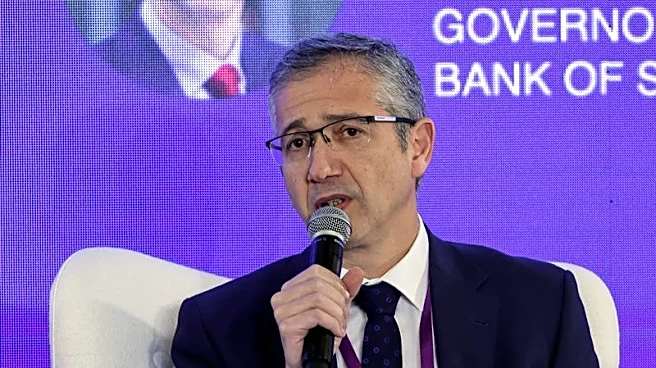
Market participants are now fully anticipating a 25-basis-point interest rate hike from the ECB in December, with further increases projected through 2027. The ECB's inflation-fighting efforts are expected to continue under new leadership, as European leaders support Pablo Hernandez de Cos to succeed Christine Lagarde, whose term concludes early on February 7. Both Vujcic and Kocher expressed confidence in Hernandez de Cos, citing his monetary policy expertise and international experience. The ongoing monitoring of energy prices will be crucial, as prolonged high prices could trigger second-round inflation, necessitating further policy responses. The resilience of the eurozone economy will also be a key factor in future decisions, as stronger growth might provide more room for the ECB to continue tightening. Investors will closely watch upcoming inflation data and official communications from the ECB for further guidance on the pace and extent of future rate adjustments.
Beyond the Headlines
The ECB's sustained focus on combating inflation, even at the risk of potentially slowing economic growth, reflects a broader global challenge faced by central banks in maintaining price stability amidst complex economic conditions. The emphasis on structural economic problems contributing to Europe's low potential growth rate suggests that monetary policy alone may not be sufficient to address underlying economic weaknesses. This could prompt calls for deeper structural reforms within eurozone member states to enhance long-term growth prospects. Furthermore, the transition in ECB leadership to Pablo Hernandez de Cos will be closely watched for any shifts in policy approach or communication style, although current indications suggest a continuation of the existing inflation-fighting mandate. The ongoing debate about the euro's strength against the U.S. dollar, which Vujcic dismissed as trading within its historical range, highlights the continuous interplay between monetary policies, economic performance, and currency valuations in the global financial system.