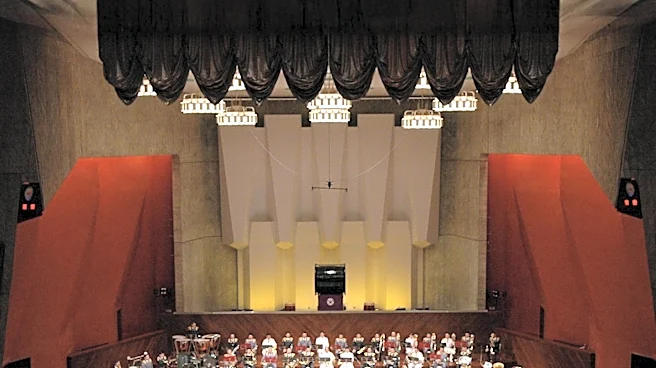







What's Happening?
Joe Hisaishi, the renowned 75-year-old Japanese conductor, composer, and pianist, recently presented the UK premiere of his Concerto for Orchestra at the Royal Albert Hall in London. While widely recognized for his extensive work on Studio Ghibli film
soundtracks, Hisaishi demonstrated his significant standing in the classical music world by selling out the venue for an evening that featured compositions by Steve Reich, David Lang, and his own new concerto, notably without any film scores. The Concerto for Orchestra, co-commissioned by 11 ensembles across six countries, reflects a diverse musical heritage, incorporating elements of American minimalism, Vivaldi, Stravinsky, Bernard Herrmann, and Caribbean influences. The piece is structured into five movements, identified only by number, and explores intricate patterns, layered textures, and varied rhythmic structures, including jazz-style breaks for different instrument sections. Hisaishi's collaboration with the Royal Philharmonic Orchestra (RPO) highlighted the orchestra's precision and ability to navigate the complex score, seamlessly transitioning between solo and ensemble passages.
Why It's Important?
This event underscores the evolving landscape of classical music and its potential to attract broad audiences, challenging the notion that the genre is in decline. Hisaishi's ability to draw a sold-out crowd to a program devoid of his popular film scores demonstrates that his artistic merit extends beyond his well-known cinematic contributions. This success can inspire other contemporary composers to explore diverse influences and push the boundaries of orchestral music, potentially fostering greater public engagement with classical compositions. The international co-commissioning of his concerto also highlights a growing trend of global collaboration in the arts, enabling larger-scale projects and broader dissemination of new works. For the music industry, it signals that artists with crossover appeal can effectively bridge the gap between popular and classical genres, expanding the audience base for both.
What's Next?
The successful UK premiere of Hisaishi's Concerto for Orchestra suggests a potential for further international performances and increased recognition of his classical compositions. Given the concerto's co-commissioning by multiple international ensembles, it is likely to be performed in other countries involved in its creation, broadening its global reach. This could lead to more collaborations between Hisaishi and other prominent orchestras worldwide, further solidifying his reputation as a significant contemporary classical composer. The positive reception may also encourage more venues to program contemporary classical works, potentially fostering a more vibrant and diverse classical music scene. Additionally, Hisaishi's continued success could inspire a new generation of composers to blend diverse musical traditions, leading to innovative and accessible classical music that appeals to a wider demographic.
Beyond the Headlines
Hisaishi's career trajectory, moving from highly successful film scoring to critically acclaimed classical compositions, exemplifies a broader cultural shift where artistic boundaries are becoming increasingly fluid. This challenges traditional hierarchies within music, suggesting that popular success can be a pathway to serious artistic recognition in classical spheres, rather than a detractor. The international nature of the concerto's commissioning and its diverse musical influences also reflect a globalized artistic environment, where cross-cultural pollination enriches creative output. This trend could lead to a more inclusive and diverse classical music canon, moving beyond historically Eurocentric traditions. Furthermore, Hisaishi's ability to engage audiences without relying on familiar film themes highlights the enduring power of well-crafted music to resonate on its own terms, fostering a deeper appreciation for instrumental artistry and complex compositional structures.