

What's Happening?
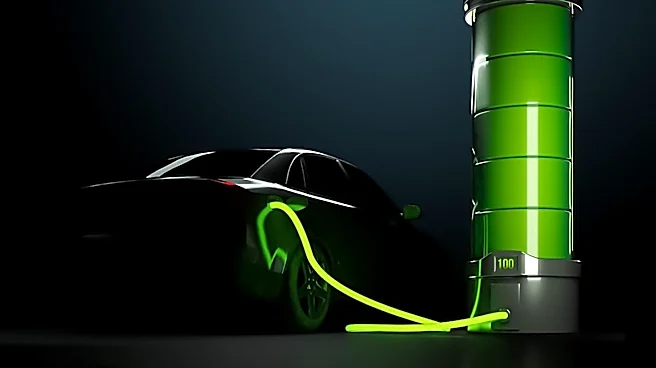
Hongqi, a luxury brand under China FAW Group, has announced a breakthrough in electric vehicle (EV) battery technology with a prototype that can charge from 10% to 70% in just 3 minutes and 41 seconds. This development positions Hongqi as a potential
leader in the EV market, challenging existing standards set by competitors like BYD. The prototype utilizes a 12C peak charging rate and features an adaptive thermal management system to prevent overheating. This system continuously monitors battery conditions, adjusting cooling strategies to maintain optimal performance. The battery's design includes a custom low-desolvation electrolyte and a composite carbon-coated anode, reducing internal resistance and enhancing ion flow. While the prototype shows promise, it currently lacks a production schedule and commercial application.
Why It's Important?
The introduction of such rapid charging technology could significantly impact the EV industry by reducing charging times, a major barrier to EV adoption. If Hongqi can commercialize this technology, it could enhance the appeal of EVs, particularly for long-distance travel, by minimizing downtime at charging stations. This advancement could also pressure other automakers to accelerate their own battery technology developments, potentially leading to a faster transition from internal combustion engines to electric vehicles. The competitive edge gained by Hongqi could help it expand its market presence globally, challenging established automakers in Europe and the Middle East.
What's Next?
For Hongqi, the next steps involve moving from prototype to production, which will require overcoming technical and logistical challenges. The company will need to establish a reliable supply chain for the new battery components and ensure the technology meets safety and regulatory standards. Additionally, Hongqi's ability to scale production and integrate this technology into its vehicle lineup will be crucial. The broader industry will likely watch closely, as successful commercialization could set a new benchmark for EV charging standards.