

What's Happening?
ASRock Industrial announced the release of its RBK-100 Robotics-in-a-Box on November 24, 2026. This integrated platform is designed to simplify the development of Physical AI for researchers, educators, and developers. The RBK-100 combines an Intel-based
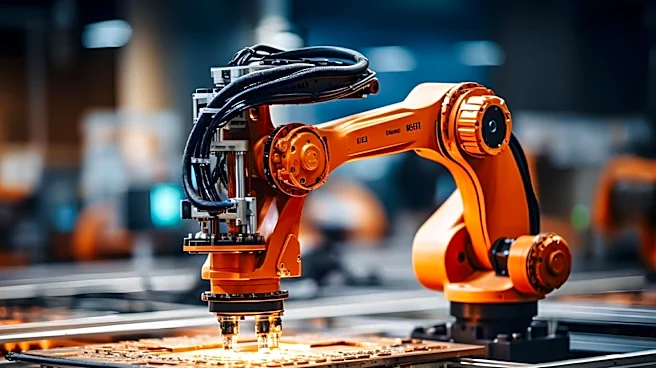
edge computer, an RGB-D camera, a set of paired robotic arms, and pre-installed AiRoboStarter software. The primary goal of this kit is to reduce the complexities associated with integrating various components in robotic AI development, allowing users to concentrate on model experimentation and learned manipulation tasks. The system supports a workflow that includes demonstration recording, dataset review, model training, and robot-skill execution. The computing platform is the ASRock Industrial NUC BOX-358H, featuring an Intel Core Ultra X7 Processor 358H for local AI processing, with configurations offering 32GB or 64GB of DDR5 memory and a 512GB M.2 PCIe Gen4 SSD. The robotic arm set provides six degrees of freedom for tasks like pick-and-place and object handling.
Why It's Important?
The RBK-100 is significant because it addresses a major hurdle in the advancement of Physical AI: the complex and time-consuming integration of hardware and software components. By providing a ready-to-use, integrated platform, ASRock Industrial aims to democratize access to robotic AI development. This could accelerate innovation in fields such as robotic manipulation research and education, as developers can bypass initial setup challenges and move directly to experimenting with AI models and robotic behaviors. The collaboration with Intel, as highlighted by John Healy, vice president and general manager of Intel’s Industrial and Robotics Division, underscores the need for an open technology foundation to scale Physical AI. This platform could foster a new generation of AI-driven robotic applications by making the development process more efficient and accessible, potentially leading to breakthroughs in automation and intelligent systems across various industries.
What's Next?
The RBK-100 is positioned to evolve with future software releases and hardware specifications. ASRock Industrial plans to add SmolVLA support to its AiRoboStarter software in the future, which would further enhance the platform's capabilities. The current configurations, including a standard package focused on learning manipulation skills and an Advanced configuration with agentic AI workflows, suggest a roadmap for expanding functionality. The Advanced version, which integrates voice interaction, AI reasoning, visual perception, and trained robotic skills, indicates a move towards more sophisticated multimodal AI applications. As the platform is labeled as preliminary with specifications subject to change, ongoing updates to components and software are expected. This continuous development will likely broaden the RBK-100's practical scope and its utility for complex robotic tasks, potentially attracting a wider range of developers and researchers seeking advanced Physical AI solutions.
Beyond the Headlines
The launch of the RBK-100 signifies a broader trend towards making advanced AI and robotics more accessible, moving beyond theoretical models to practical, physical applications. This 'Robotics-in-a-Box' concept could lower the barrier to entry for smaller research institutions, educational programs, and individual developers who may lack the resources for extensive custom system integration. The emphasis on an integrated path from physical demonstrations to model training and execution highlights a shift towards more intuitive and hands-on AI development. This approach could foster greater creativity and experimentation in robotics, potentially leading to novel applications in manufacturing, logistics, healthcare, and domestic assistance. Furthermore, by simplifying the development process, ASRock Industrial and Intel are contributing to the broader ecosystem of Physical AI, which could accelerate the transition of AI from virtual environments to tangible interactions with the real world, raising new ethical and societal considerations regarding autonomous systems.