



What's Happening?
U.S. financial sanctions, particularly those targeting Iran and China, are encountering increasing limitations and diminishing returns. Despite warnings from U.S. Treasury Secretary Scott Bessent regarding potential sanctions on Chinese banks facilitating
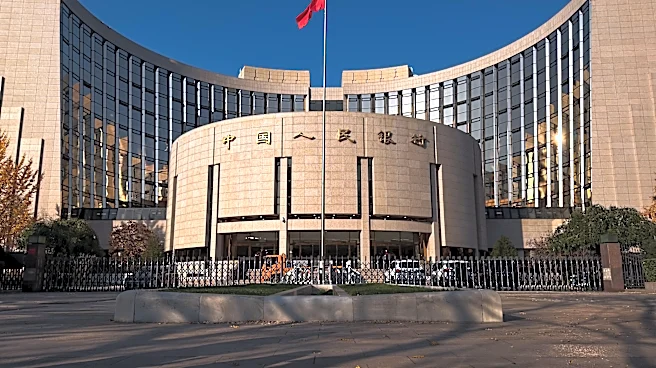
Iranian oil transactions, Chinese institutions have largely maintained links with Iranian entities. This reflects a broader shift where traditional U.S. financial chokepoints are becoming less effective. Major Chinese banks reduced direct business with Iran around 2007-2008, but trade continued through indirect channels, often utilizing Renminbi settlement and China’s Cross-Border Interbank Payment System (CIPS). The architecture of sanctions evasion has evolved to include alternative digital ledgers, intermediary tiers, and local currencies, making investigation and sanctioning more challenging. Historically, the U.S. has sanctioned only a small, localized bank, the Xinjiang-based Bank of Kunlun, for its ties to Iran, but expanding entity lists beyond such cases has proven costly with limited strategic impact.
Why It's Important?
The declining efficacy of U.S. financial sanctions has significant implications for U.S. foreign policy and economic leverage. As alternative payment channels and currencies gain traction, the ability of the U.S. to unilaterally impose decisive costs on targeted entities is reduced. This shift affects U.S. industries by potentially weakening the dollar's global dominance and increasing the complexity of international trade and finance. For U.S. politics, it suggests a need to re-evaluate the effectiveness of sanctions as a primary foreign policy tool. The constraint of systemically important banks (GSIBs) further complicates matters; sanctioning major Chinese lenders like ICBC or China Construction Bank could trigger systemic shocks across international clearing networks, impacting U.S. banks and multinational corporations. This creates a more symmetric interdependence, where imposing sanctions can also incur heavy costs for the sanctioning state and its partners.
What's Next?
The U.S. government may need to refine its approach to financial sanctions, focusing on more precise targeting, enhanced allied coordination, and realistic objectives. The current trend suggests that repeated secondary sanctions might accelerate the diversification away from dollar-denominated transactions, further eroding U.S. leverage. The international financial system is likely to continue fragmenting, with states increasingly mixing Western and non-Western systems to protect their access, profit, and autonomy. This could lead to a more contested and selective application of economic pressure, rather than the absolute coercion seen in the past. The emergence of alternative payment options and the growing importance of non-Western financial institutions will likely necessitate a re-evaluation of U.S. diplomatic and strategic tools beyond financial coercion.
Beyond the Headlines
The weakening impact of U.S. sanctions on Iran serves as a structural signal of a broader transformation in global finance. This development highlights the ethical and legal complexities of extraterritorial sanctions, particularly when they impact the global financial system. The rise of Renminbi settlement, CIPS, and layered evasion networks challenges the long-held assumption of asymmetric interdependence, where Western authorities could exploit central financial hubs with minimal self-damage. This shift could trigger long-term changes in global economic governance, moving towards a multipolar financial system where no single currency or payment network holds absolute sway. The U.S. will need to navigate this evolving landscape, balancing its national security interests with the potential for unintended consequences on its own economy and global financial stability.