


What's Happening?
Researchers at the Technical University of Munich (TUM) have developed a new AI model that enables robots to recognize their own limitations and continuously learn new skills without forgetting previous knowledge or endangering humans. This 'self-reflective'
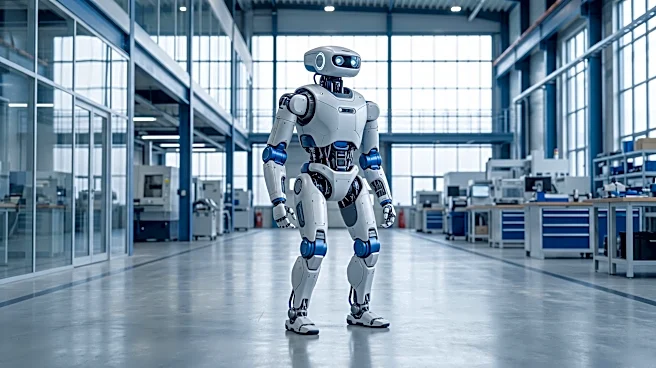
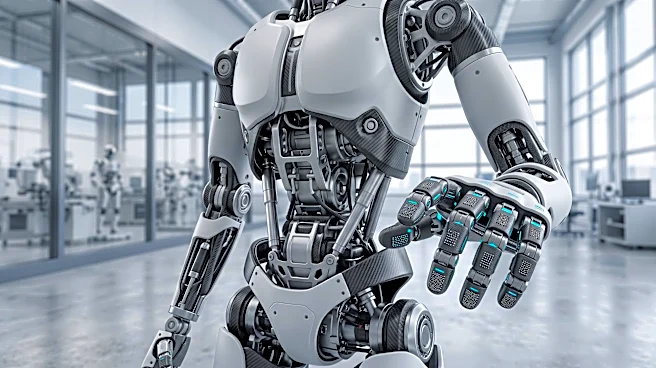
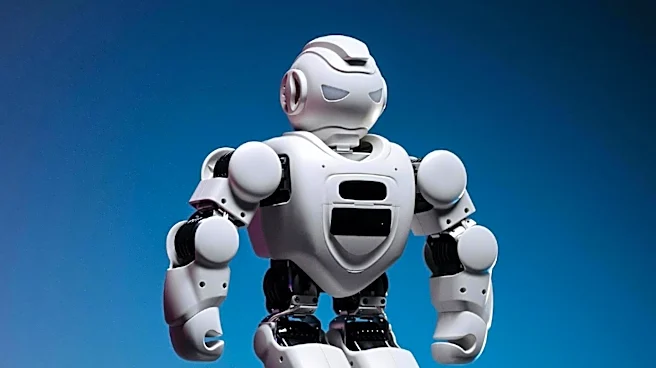
robot, developed by a team led by Ralf Römer and Professor Angela Schoellig, uses a vision-language-action (VLA) model, similar to large language models but adapted for real-world robotic actions. When the robot encounters an unfamiliar situation it cannot handle, it stops and waits for human assistance. This allows researchers to specifically retrain the system on these uncertain situations, generating additional data and reducing overall training time by up to 20%. A key innovation is the use of adapters within the AI model, which store new information separately, preventing 'catastrophic forgetting' where new learning overwrites old knowledge. This means the robot can learn new manipulation skills within the same AI model, enhancing its adaptability and safety.
Why It's Important?
This development is crucial for the safe and effective integration of AI-controlled robots into real-world environments, particularly in the U.S. where automation is expanding across industries. By enabling robots to recognize their limitations and request help, the technology significantly enhances safety, a primary concern for human-robot collaboration. The ability for continuous learning without forgetting past skills addresses a major challenge in AI development, making robots more versatile and adaptable over time. This could lead to more efficient and reliable robotic systems in manufacturing, logistics, healthcare, and other sectors, potentially boosting productivity and innovation. For businesses, it means robots can be deployed in more complex and dynamic environments, reducing the need for constant human supervision and retraining. For workers, it could foster greater trust in robotic systems, as the robots are designed to operate more predictably and safely.
What's Next?
The next steps involve further refinement and testing of the 'self-reflective' AI model in diverse real-world scenarios to validate its robustness and scalability. Researchers will likely explore how to optimize the number and management of adapters for storing new information, as well as investigate more sophisticated methods for human-robot interaction during learning phases. Commercial applications could emerge as the technology matures, with potential for integration into industrial robots, service robots, and even autonomous vehicles. The development could also influence future AI research, particularly in areas of lifelong learning and explainable AI. Regulatory bodies may need to consider new standards and guidelines for robots equipped with such self-awareness capabilities, ensuring their safe deployment and ethical operation in public and industrial spaces.
Beyond the Headlines
The concept of a 'self-reflective' robot touches upon deeper philosophical and ethical questions about artificial intelligence. By recognizing its own limitations, the robot exhibits a rudimentary form of self-awareness, which could be a stepping stone towards more sophisticated AI cognition. This development challenges traditional notions of machine intelligence, moving beyond mere task execution to include an understanding of competence boundaries. The increased trust that people develop in these systems, as noted by Professor Schoellig, highlights the psychological impact of AI design on human acceptance and collaboration. Long-term, this technology could contribute to a future where AI systems are not just tools, but intelligent partners capable of adaptive learning and responsible decision-making within their defined operational limits, potentially reshaping the nature of work and human-technology interaction.