




What's Happening?
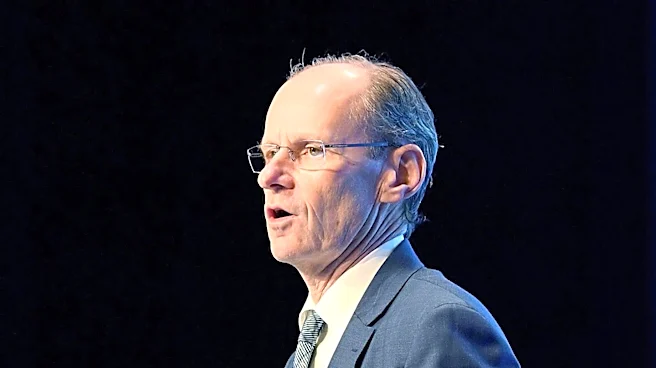
Isabel Schnabel, Member of the Executive Board of the European Central Bank (ECB), delivered a speech in Vilnius on November 13, 2026, addressing Europe's position amidst radical transformations driven by technological progress and profound geopolitical
shifts. Schnabel challenged the narrative portraying Europe as a continent in decline, arguing that it possesses a high quality of life, strong institutions, social protection, and adaptability. She emphasized that Europe's key challenge is not a lack of talent or ideas, but a lack of scale, particularly in its Single Market. Schnabel advocated for unlocking the full potential of the Single Market to enable Europe to compete as one economy rather than 27. She highlighted that despite decades of integration, regulatory and administrative barriers still obstruct the free movement of services and goods, creating internal 'tariff walls.' To address this, she proposed the creation of a '28th regime' – a unified European corporate framework that would allow companies to incorporate as genuinely European firms, operating under a single set of rules for core elements of company law, governance, shareholder rights, and employee financial compensation.
Why It's Important?
While focused on Europe, Schnabel's analysis of geopolitical shifts and the need for economic scale has significant implications for the U.S. The U.S. economy and its businesses operate within a globalized framework, and a stronger, more unified European market could alter global trade dynamics, investment flows, and competitive landscapes. If Europe successfully implements a '28th regime' and achieves greater economic scale, it could become a more formidable competitor to the U.S. in various sectors, particularly technology and innovation. This could lead to increased competition for talent, capital, and market share globally. Conversely, a more robust European economy could also present new opportunities for U.S. businesses through increased trade and investment partnerships. The U.S. government and businesses will need to monitor these developments closely to adapt their strategies, ensuring continued competitiveness and fostering beneficial transatlantic economic relations. The speech also underscores the broader global trend of regions seeking to consolidate economic power in response to geopolitical fragmentation.
What's Next?
The proposal for a '28th regime' is currently under discussion and, if implemented, would aim to make the incorporation process quick, cheap, and fully digital, open to companies of all sizes and sectors. The success of this initiative hinges on its legal implementation, ideally through an EU regulation directly applicable across all member states to avoid fragmentation. If successful, this regime could significantly lower barriers to cross-border activity within Europe, making it easier for companies to raise capital and attract talent, and allowing innovative companies to scale more quickly. This would help ensure that European companies, particularly startups, remain in Europe rather than seeking incorporation in places like Delaware. The U.S. will likely observe how this initiative progresses, as its success could influence global corporate legal frameworks and investment patterns. The long-term goal is to boost innovation and productivity growth in Europe, which could lead to a more balanced global economic power distribution.
Beyond the Headlines
Schnabel's speech touches upon a fundamental challenge for established economic blocs in a rapidly changing world: how to maintain competitiveness and foster growth amidst geopolitical fragmentation and technological disruption. The '28th regime' proposal is not merely a technical legal adjustment; it represents a strategic effort to create a 'Made in Europe' brand for companies, symbolizing innovation, excellence, and legal certainty. This initiative reflects a deeper ambition to counter the narrative of European decline and assert its economic and political influence on the global stage. For the U.S., this signifies a potential shift in the global economic order, where Europe aims to reduce its reliance on external markets and foster internal growth. The ethical implications involve ensuring that such a unified framework promotes fair competition and does not inadvertently create new barriers for non-European entities. Culturally, it could strengthen a distinct European economic identity, potentially influencing consumer preferences and business practices globally.