










What's Happening?
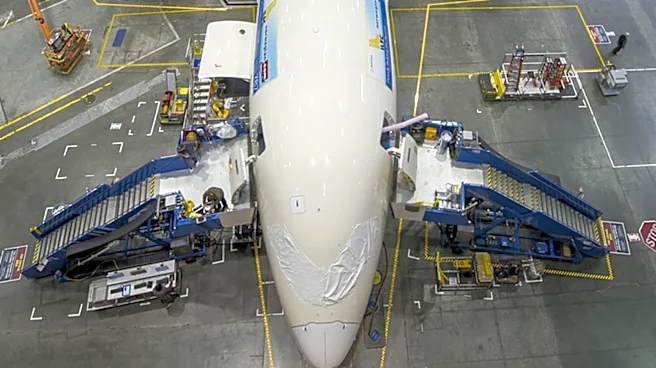
Mammoth Freighters, a Texas-based company, is set to open a Boeing 777 passenger-to-freighter conversion line in Qingdao, China. This initiative is in partnership with Taikoo (Shandong) Aircraft Engineering (STAECO) and marks Mammoth's first conversion facility
in the Asia-Pacific region. The new line will be located at Qingdao Jiaodong International Airport and is scheduled to begin operations in September. The first aircraft to undergo conversion will be a Boeing 777-200LR owned by Jetran, with a second conversion line planned for early 2027. STAECO, a joint venture involving HAECO and other partners, already performs conversions for Boeing 737-800 aircraft. Mammoth's 777-200LRMF conversion program received FAA certification in April, and the company anticipates delivering approximately 81 converted 777 freighters over the next decade.
Why It's Important?
The establishment of a conversion line in China represents a strategic expansion for Mammoth Freighters, enhancing its global footprint and capacity to meet growing demand for freighter aircraft. This move is significant for the aviation industry, particularly in the Asia-Pacific region, which is a major hub for air cargo. The partnership with STAECO leverages local expertise and infrastructure, potentially reducing costs and increasing efficiency. The expansion aligns with the broader trend of increasing air cargo capacity, driven by e-commerce growth and global supply chain demands. This development could also strengthen economic ties between the U.S. and China in the aerospace sector.
What's Next?
The first conversion line is expected to commence operations in September, with the first aircraft conversion slated for the fall. The second line is planned for early 2027, indicating a phased approach to scaling operations. Stakeholders in the aviation and logistics industries will likely monitor the success of this venture, as it could influence future investments and partnerships in the region. Additionally, the delivery of converted freighters over the next decade will be crucial in meeting the anticipated demand for air cargo services.