






What's Happening?
The Minha Casa, Minha Vida housing program in Brazil is experiencing divergent trends within São Paulo state. According to a survey by Secovi-SP, which represents the state's real estate industry, new home launches and sales under the program continue
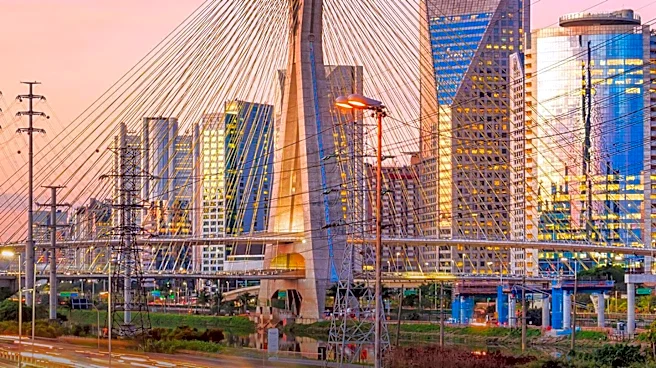
to increase in the city of São Paulo, the country's largest real estate market. In the 12 months leading up to July, new launches in the city rose by 18%, with Minha Casa, Minha Vida units increasing their share from 60% to 68% of the total. Conversely, in other cities within São Paulo state, the share of new homes launched and sold under the program declined in the first half of the year. The survey, conducted by Brain across 42 cities, indicated that Minha Casa, Minha Vida homes accounted for 48.9% of new launches in these cities, a 6.9 percentage point decrease from the previous year. Sales also saw a smaller decline of 4.5 percentage points, reaching 45.6%. In absolute terms, 13,768 homes under the program were launched and 15,754 were sold in the first half of the year in these other cities. Despite strong sales of Minha Casa, Minha Vida homes in the capital, overall home sales in São Paulo city decreased by 2%.
Why It's Important?
This trend highlights a growing disparity in the real estate market within São Paulo state, with the capital city increasingly relying on government-backed affordable housing initiatives to drive new launches and sales. The decline of the Minha Casa, Minha Vida program's share in other cities, despite an increase in the value of sales and launches, suggests a shift towards higher-end properties in those regions. This indicates a potential economic stratification where wealthier buyers are increasingly concentrated outside the capital, while the capital's market is sustained by more accessible housing options. The slowdown in the mid- and high-end segments within São Paulo city, characterized by longer sell-out times and increased buyer negotiation power, points to an oversupply or reduced demand in these categories. This could impact developers' strategies, potentially leading to a greater focus on affordable housing in the capital and more luxury developments in other parts of the state. The struggle of middle-income buyers, who do not qualify for the Minha Casa, Minha Vida program, to secure affordable mortgage financing further exacerbates the market's challenges.
What's Next?
The real estate industry in São Paulo city will likely continue to monitor the performance of the Minha Casa, Minha Vida program, as its expansion appears crucial for sustaining new launches. Developers in the capital's mid- and high-end segments may need to adjust their pricing strategies or offer more incentives to attract buyers, given the increased time to sell out new developments and buyers' enhanced negotiating power. In other cities within São Paulo state, the trend of increasing sales value despite fewer launches and sales suggests a continued focus on higher-end properties. This could lead to further investment in luxury developments outside the capital. The challenges faced by middle-income buyers in securing affordable mortgage financing may prompt calls for policy adjustments or new financial products to address this segment of the market. The economic performance of cities outside the capital, which is cited as a driver for the shift towards more expensive properties, will be a key factor in shaping future real estate development across the state.
Beyond the Headlines
The diverging real estate trends within São Paulo state reflect broader socio-economic shifts and urban development patterns. The increasing reliance of São Paulo city on affordable housing programs like Minha Casa, Minha Vida could indicate a growing need to address housing affordability for a significant portion of its population, potentially driven by urbanization and income disparities. Conversely, the rise of higher-end markets in other cities within the state suggests a decentralization of wealth and economic activity, with these areas becoming more attractive to affluent residents and developers. This could lead to increased infrastructure development and job creation in these burgeoning urban centers. The observation that the movement of people from the state capital to other cities during the pandemic no longer drives the current trend, but rather the economic performance of these cities, highlights a more fundamental and sustained shift in regional economic dynamics. This could have long-term implications for urban planning, resource allocation, and social equity across São Paulo state, as different regions develop distinct economic and demographic profiles.