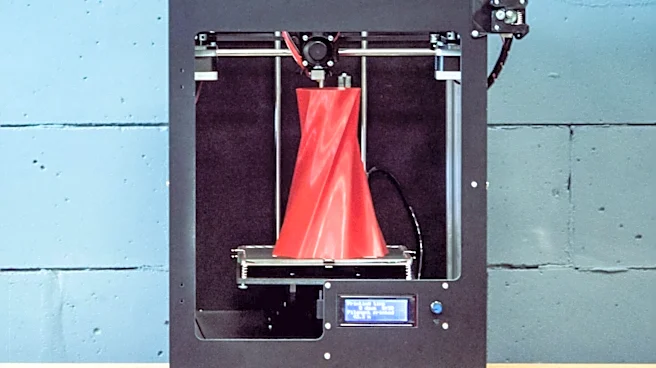









What's Happening?
Two startups, Poland's Orbital Matter and Germany's Dcubed, are conducting on-orbit demonstrations of 3D printing technology within the vacuum of space using cubesats. This initiative is a crucial step towards the goal of creating solar arrays with additively
manufactured booms directly in space. The ability to 3D print structures in orbit could revolutionize how spacecraft are designed, built, and deployed, potentially enabling larger and more complex structures than currently possible with ground-based manufacturing and launch constraints. These demonstrations are focused on proving the feasibility and reliability of additive manufacturing in the harsh space environment, paving the way for future in-space construction capabilities.
Why It's Important?
The development of 3D printing in the vacuum of space holds immense importance for the U.S. space industry and its strategic objectives. This technology could significantly reduce the cost and complexity of launching large space structures, as components could be manufactured and assembled in orbit rather than being built on Earth and folded for launch. This would enable the creation of larger, more powerful solar arrays for satellites and space stations, enhancing power generation capabilities. It also opens doors for in-space manufacturing of other critical components, potentially leading to more resilient and adaptable space infrastructure. For U.S. companies, this innovation could foster new economic opportunities in space services, manufacturing, and exploration, providing a competitive edge in the global space race and supporting long-duration missions to the Moon and Mars.
What's Next?
The immediate next steps for Orbital Matter and Dcubed involve analyzing the data from their on-orbit 3D printing demonstrations to validate the technology's performance in the space vacuum. Success in these initial tests will likely lead to further, more complex demonstrations, potentially involving larger structures or different materials. The long-term goal is to move towards the commercial application of in-space manufacturing, starting with components like solar array booms. This will require continued research and development to refine printing techniques, ensure material integrity in space, and develop autonomous assembly processes. Future efforts will also focus on scaling up the technology to produce larger and more intricate structures, which could eventually support the construction of entire space habitats or advanced propulsion systems directly in orbit.
Beyond the Headlines
The ability to 3D print in space has profound implications that extend beyond immediate cost savings and larger solar arrays. It represents a fundamental shift towards true space industrialization, where humanity can become less reliant on Earth for manufacturing and more self-sufficient in its extraterrestrial endeavors. This could lead to the development of permanent lunar bases or Martian colonies, as structures and tools could be fabricated on-site using local resources or recycled materials. Ethically, it raises questions about resource ownership in space and the potential for environmental impact in orbital or planetary environments. Culturally, it could inspire a new era of space exploration and settlement, fundamentally altering humanity's relationship with the cosmos and fostering a new generation of engineers and innovators focused on off-world living and working.