





What's Happening?
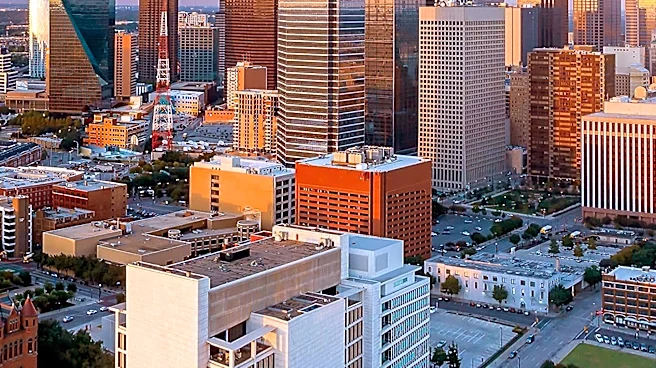
Dallas has surpassed New York City in the share of jobs dedicated to financial activities, with 10.1% of its employment in the sector compared to New York's 9.9%, according to Federal Reserve Bank of Dallas data through June 2026. This marks Dallas as the leading
U.S. metro area by this metric. Since February 2020, Dallas's financial-activities employment has grown by 23.2%, significantly outpacing New York's 6%. Other major financial hubs like Chicago, Boston, and San Francisco remain below their pre-pandemic employment levels in this sector. The Dallas Fed's definition of financial activities includes finance, insurance, and real estate. While Dallas leads in percentage share, New York City still maintains a larger total headcount in the financial sector. Ari Rastegar, founder and CEO of Rastegar Capital, has popularized the term 'Y'all Street' to describe Dallas's growing financial prominence, a term now widely used in business discussions.
Why It's Important?
This shift signifies a broader economic realignment within the U.S., highlighting the growing influence of Sun Belt cities as financial centers. The migration of financial jobs to Dallas is driven by factors such as lower taxes, a more affordable cost of living, and favorable zoning policies compared to traditional financial hubs on the coasts. This trend impacts real estate markets, labor dynamics, and urban development in both the gaining and losing regions. For Dallas, it solidifies its position as a major economic player, attracting significant investment and corporate relocations, including major expansions by firms like Goldman Sachs. For New York, it signals a potential long-term challenge to its dominance in the financial sector, prompting questions about its competitiveness and future growth strategies. The rise of 'Y'all Street' reflects a changing landscape where operational costs and quality of life are increasingly influencing corporate location decisions.
What's Next?
The Texas Stock Exchange, which began trading in July 2026, is expected to list its first corporate entities in the fourth quarter, further solidifying Dallas's financial infrastructure. Goldman Sachs's new 800,000-square-foot Dallas campus, designed for over 5,000 employees, is slated to open in 2028, indicating continued expansion by major financial institutions. Additionally, Morgan Stanley is reportedly in advanced discussions for a $1.3 billion operational hub in Dallas. These developments suggest a sustained influx of financial sector jobs and investment into the region. The ongoing migration from 'blue states' to states like Texas, driven by tax and cost-of-living advantages, is likely to continue, further fueling Dallas's growth. The success of the Texas Stock Exchange in attracting corporate listings will be a key indicator of the region's long-term financial market viability.
Beyond the Headlines
The emergence of Dallas as a leading financial hub reflects deeper societal and economic shifts, including the decentralization of economic power away from traditional coastal centers. This trend is not merely about job numbers but also about the evolving preferences of businesses and individuals for environments that offer a better balance of cost, quality of life, and regulatory frameworks. The 'Y'all Street' phenomenon could lead to a more diversified national financial landscape, potentially fostering greater competition and innovation outside of established financial ecosystems. It also raises questions about urban planning and infrastructure development in rapidly growing cities like Dallas, which must accommodate significant population and business influxes. The long-term implications include potential shifts in political influence, as economic power often correlates with political leverage, and a re-evaluation of urban policies in both growing and declining financial centers.