



What's Happening?
Joel Shapiro, a clinical associate professor of managerial economics and decision sciences at Kellogg, has developed a new metric called 'Percent Cash Wasted' to quantify the economic cost of player injuries in the NFL. This metric calculates the portion
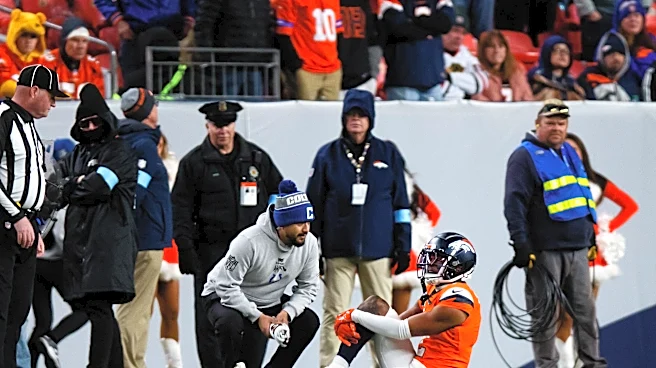
of a team's payroll that is sidelined due to injuries each season. Shapiro applied this metric to over 350 NFL team seasons between 2012 and 2022. His findings confirm that injuries do affect team success, but the magnitude of this impact is often overestimated by common wisdom within and outside football organizations. A significant exception to this trend is highly paid quarterbacks, whose absence due to injury has a more substantial impact. The research aims to provide a more precise understanding of how much injuries truly matter to a team's financial and on-field performance, moving beyond anecdotal evidence and incomplete information.
Why It's Important?
This new metric is important because it offers an economic framework for NFL teams to better understand and manage the financial implications of player injuries. In a league governed by a salary cap, teams have finite resources, and accurately valuing all components of their roster, including the risk of injury, is crucial for strategic budget allocation. By quantifying the 'cash wasted' on injured players, teams can make more informed decisions about player contracts, roster construction, and injury prevention strategies. This could lead to shifts in how teams prioritize spending, potentially influencing investments in medical staff, training facilities, or even player insurance. The finding that injuries are less impactful than commonly believed, except for highly paid quarterbacks, could prompt teams to re-evaluate their risk assessment for different player positions and salary tiers, ultimately affecting player valuation and contract negotiations across the league.
What's Next?
The introduction of the 'Percent Cash Wasted' metric could lead to its adoption by NFL front offices and sports analysts seeking more data-driven approaches to team management. Teams might begin incorporating this metric into their internal financial models and player evaluation processes, potentially influencing decisions related to player acquisitions, contract extensions, and salary cap management. Further research could expand on this metric, perhaps by integrating performance data to correlate 'cash wasted' with actual on-field win-loss records more directly. Additionally, the findings might spark discussions among team owners and the NFL Players Association regarding injury protocols, player safety, and the financial protections for both players and teams in the event of significant injuries. The focus on highly paid quarterbacks suggests that teams may intensify efforts to protect these key assets, potentially through specialized training regimens or more robust backup plans.
Beyond the Headlines
Beyond the immediate financial and strategic implications for NFL teams, this research highlights a broader trend of applying rigorous economic analysis to sports. It underscores how data science and quantitative methods are increasingly being used to demystify complex aspects of professional sports, moving beyond traditional scouting and intuition. This approach could influence other professional sports leagues facing similar challenges with player injuries and salary caps. Ethically, the metric could prompt discussions about the value placed on different players and positions, and whether the economic cost of an injury fully captures its human and team morale impact. Legally, it might inform future collective bargaining agreements regarding injury clauses and player compensation. Culturally, it reinforces the idea that even in highly physical and unpredictable sports like football, economic principles play a fundamental role in decision-making and competitive strategy.