


What's Happening?
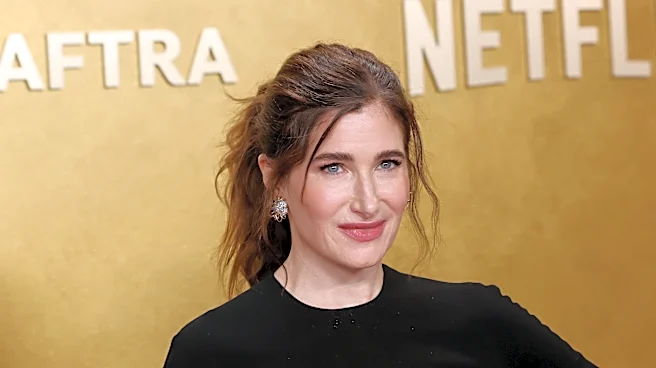
Actress Kathryn Hahn recently shared an uncomfortable encounter with a fan who quoted an explicit line from her 2008 film 'Step Brothers' in front of her children. During an appearance on Kylie Kelce's 'Not Gonna Lie' podcast, Hahn recounted walking with her son
and daughter when a stranger shouted the risqué dialogue. She expressed her surprise and discomfort, noting that her children were younger at the time. Hahn also mentioned that fans frequently repeat a line about wearing a 'poncho' from her role as Jennifer Barkley in 'Parks and Recreation,' a more family-friendly reference. Hahn shares a 20-year-old son, Leonard Sandler, and a 17-year-old daughter, Mae Sandler, with her husband Ethan Sandler.
Why It's Important?
This incident highlights the challenges public figures face in managing their personal and professional lives, especially when their work involves mature content. The unsolicited recitation of explicit movie lines in a public setting, particularly in front of children, underscores a lack of boundaries some fans may exhibit. For actors like Hahn, whose careers span diverse roles, the public's perception can sometimes conflate their on-screen personas with their real-life identities. This can lead to awkward or inappropriate interactions that impact their privacy and family life. The contrast between the 'Step Brothers' quote and the 'Parks and Recreation' 'poncho' line illustrates the varying degrees of fan engagement and the need for discretion when interacting with celebrities.
What's Next?
While there are no specific 'next steps' for this particular incident, it serves as a reminder for public figures and their families about the potential for unexpected fan interactions. Celebrities often develop strategies to navigate public life, which may include being more selective about public appearances with their children or having security present. For fans, the story implicitly encourages greater awareness and respect for personal boundaries when encountering public figures, recognizing that actors are individuals with private lives and families. The ongoing nature of celebrity culture means such encounters are likely to continue, prompting ongoing discussions about fan etiquette and celebrity privacy.
Beyond the Headlines
The incident touches upon broader themes of celebrity culture, fan behavior, and the blurring lines between public and private life in the digital age. It raises questions about the responsibility of fans to respect personal boundaries and the impact of media consumption on public interaction. The prevalence of social media and constant access to celebrity content can sometimes foster a sense of familiarity that oversteps appropriate social norms. This event also subtly underscores the ethical considerations for media outlets in how they portray and discuss such interactions, balancing public interest with the privacy and well-being of individuals, especially when children are involved.